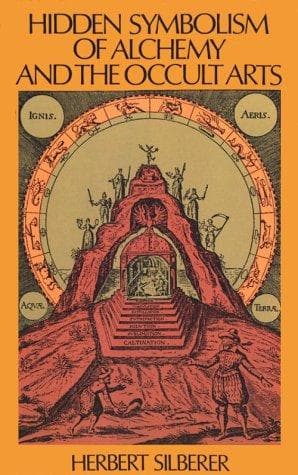
Hidden Symbolism of Alchemy and the Occult ArtsSilberer, Herbert
Religion
Hidden Symbolism of Alchemy and the Occult Arts
Silberer, Herbert
Alchemy; Society of Rosicrucians; Symbolism (Psychology)
The choice of a symbol is strongly influenced by what strongly impresses
the mind, what moves the soul, whether joyful or painful, what is of vital
interest, in short, whatever touches us nearly, whether consciously or
unconsciously. This influence is shown even in the commonplace instances,
where the professional or the amateur is betrayed by the manner of
apperceiving one and the same object. Thus the landscape painter sees in a
lake a fine subject, the angler an opportunity to fish, the business man a
chance to establish a sanitarium or a steamboat line, the yachtsman a
place for his pleasure trips, the heat tormented person a chance for a
bath, and the suicide, death. In the symbolic conception of an object,
moreover (which is much more dependent on the unconscious or uncontrolled
stimulation of the phantasy that shapes the symbol), the choice from among
the many possibilities can surely not fall upon such images as are
unsympathetic or uninteresting to the mind. Even if we consciously make
comparisons we think of an example mostly from a favorite and familiar
sphere; when something “occurs” to us there is already evidenced some part
of an unconscious complex. This will become elaborated in the degree that
the phantasy is given free play.
The raw product then, of the symbol-choosing phantasy of the individual
(“raw,” i.e., not covered for publicity with a premeditated varnish) bears
traces of the things that closely concern the person in question. (“Out of
the fulness of the heart the mouth speaketh”—even without premeditation.)
If we now start from a spiritual product which is expressed in symbols
(mythologically apperceived), and whose author we must take to be not an
individual man but many generations or simply mankind, then this product
will, in the peculiarities of the selection of the symbol, conceivably
signify not individual propensities but rather those things that affect
identically the generality of mankind. In alchemy, which as a
mythologically apperceiving science is completely penetrated by symbols,
we regard as remarkable in the selection of symbols, the juxtaposition of
such images as reflect what we have, through psychoanalysis, become
acquainted with, as the “titanic” impulses (Œdipus complex). No wonder!
These very impulses are the ones that we know from psychoanalytic
investigations as those which stand above all individual idiosyncracies.
And if we had not known it, the very circumstances of alchemy would have
taught us.
Public-domain text, read in full here on John Shaqi.
Reviews
Reviews
No reviews yet
Be the first to share your thoughts on this work.
Elsewhere in the archive
Join the Discussion
Join the discussion
Sign in to leave a comment or review.
Sign InorCreate an account