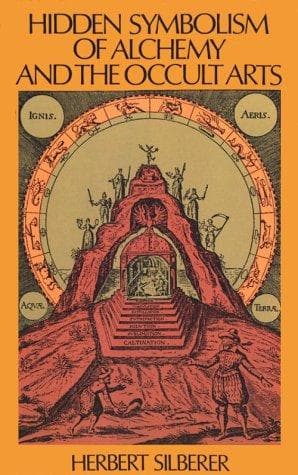
Hidden Symbolism of Alchemy and the Occult ArtsSilberer, Herbert
Religion
Hidden Symbolism of Alchemy and the Occult Arts
Silberer, Herbert
Alchemy; Society of Rosicrucians; Symbolism (Psychology)
What we have found in alchemy we shall now apply to mythology where
analogous relations have been indicated. [The apperception theory here
used should not be confused with the intellectual theory (of Steinthal)
which Wundt (V. Ps., IV2, pp. 50 ff.) criticised as the illusion theory. I
should be more inclined to follow closely the Wundtian conception of the
“mythological apperception” (ibid., pp. 64 ff.) with particular emphasis
on the affective elements that are to work there. With Wundt, the affects
are really the “actual impulse mainsprings” and the most powerful stimuli
of the phantasy (ib., p. 60). “The affects of fear and hope, wish and
desire, love and hate, are the widely disseminated sources of the myth.
They are, of course, continually linked with images. But they are the ones
that first breathe life into these images.” I differ from Wundt in that I
have more definite ideas of the origin of these affects, by which they are
brought into close connection with the frequently mentioned elementary
motives.] Modern investigation of myths has, in my opinion, sufficiently
shown that we are here concerned with a nucleus of natural philosophy
(comprehension of astral and even of meteorological processes, etc.)
around which legendary and historical material can grow. As has been shown
by two fairy tales and as I could have abundantly shown from countless
others, the psychoanalytic and the anagogic interpretations are possible
alongside of the scientific. [We can criticise Hitchcock for having in his
explanations of fairy tales considered them only in their most developed
form, and not bothered about their origin and archaic forms. And as a
matter of fact the more developed forms permit a very much richer anagogic
interpretation than the archaic. But that is no proof against the
interpretation, but only establishes their orientation in the development
of the human spirit. The anagogic interpretation is indeed a prospective
explanation in the sense of an ethical advance. Now the evolution even of
fairy tales shows quite clearly a progression towards the ethical; and
inasmuch as the ethical content of the tale grows by virtue of this
evolution, the anagogic explanation is in the nature of things able to
place itself in higher developed tales in correspondingly closer
connection with mythical material.] I adduce here only one example, namely
the schema that Frobenius has derived from the comparison of numerous sun
myths. The hero is swallowed by a water monster in the west [the sun sets
in the sea]. The animal journeys with him to the east (night path of the
sun apparently under the sea). He lights a fire in the belly of the animal
and cuts off a piece of the pendant heart when he feels hungry. Soon after
he notices that the fish is running aground. (The reillumined sun comes up
to the horizon from below.) He begins immediately to cut his way out of
the animal, and then slips out (sunrise). In the belly of the fish it has
Public-domain text, read in full here on John Shaqi.
Reviews
Reviews
No reviews yet
Be the first to share your thoughts on this work.
Elsewhere in the archive
Join the Discussion
Join the discussion
Sign in to leave a comment or review.
Sign InorCreate an account