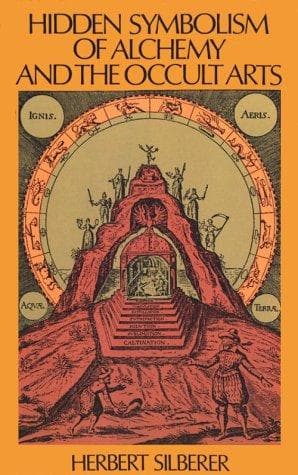
Hidden Symbolism of Alchemy and the Occult ArtsSilberer, Herbert
Religion
Hidden Symbolism of Alchemy and the Occult Arts
Silberer, Herbert
Alchemy; Society of Rosicrucians; Symbolism (Psychology)
become so hot that all his hair has fallen out. (Hair probably signifies
rays.) Quite as clear as the nature myth purport, is the fact that we have
a representation of regeneration, which is quite as conceivable in
psychoanalytic as in anagogic explanation.
Now I cannot approve of the attempt of many psychoanalysts to treat as a
negligible quantity or to ignore altogether the scientific content (nature
nucleus) of the myths which has been so well substantiated by the newer
research, even though it is not so well established in the details. [I
have uttered a similar warning in Jb. ps. F., IV (Princip. Anreg.) and
previously, in Jb. ps. F., II (Phant. u. Myth), have advocated the
equality of the natural philosophical and the psychological content. Now I
observe with pleasure that very recently an author of the psychoanalytic
school is engaged on the very subject that I have recommended as so
desirable. Dr. Emil F. Lorenz, in the February number of _Imago_, 1913,
treats the “Titan Motiv in der allgemeinen Mythologie” in a manner that
approaches my conception of it. In the consideration of human primal
motives as apperception mass, there is particularly revealed a common
thought in the primitive interpretation of natural phenomenon.
Unfortunately the article appeared after this book was finished. So even
if I am not in a position to enter into this question, I will none the
less refer to it and at the same time express the hope that Lorenz will
further elaborate the interesting preliminary contribution, communicated
in the form of aphorisms, as he terms it.] The inadmissibility of these
omissions arises from the vital importance and gripping effect of the
objects thus (i.e., mythologically) regarded by humanity (e.g., of the
course of the sun, so infinitely important for them in their dependence
upon the moods of nature). If then, on the one hand, it will not be
possible for the psychoanalyst to force the nature mythologist out of his
position and somehow to prove that any symbol means not the sun but the
father, so on the other hand the nature mythologist who may understand his
own interpretations so admirably, must not attack the specifically
psychological question: why in the apperception of an object, this and not
that symbolic image offers itself to consciousness. So, for instance, why
the sunset and sunrise is so readily conceived as a swallowing and
eructation, or as a process of regeneration. Yet Frobenius (Zeitalt. d.
Sonneng., I, p. 30) finds the symbolism “negligible.”
Public-domain text, read in full here on John Shaqi.
Reviews
Reviews
No reviews yet
Be the first to share your thoughts on this work.
Elsewhere in the archive
Join the Discussion
Join the discussion
Sign in to leave a comment or review.
Sign InorCreate an account