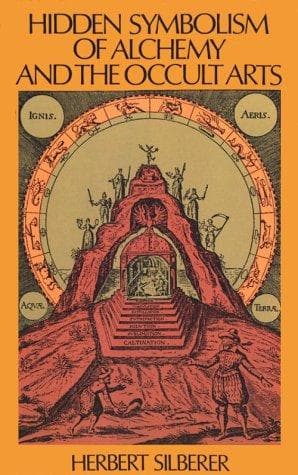
Hidden Symbolism of Alchemy and the Occult ArtsSilberer, Herbert
Religion
Hidden Symbolism of Alchemy and the Occult Arts
Silberer, Herbert
Alchemy; Society of Rosicrucians; Symbolism (Psychology)
originated in human life and thought (phantasy).”
It is indeed never conceivable that men would have chosen for the natural
phenomenon exactly these titanic symbols, if these had not had for them a
special psychic value, and therefore touched them closely. If any one
should object that they would not have “chosen” them (because they did not
purposely invent allegories, as was formerly thought), I should raise the
contrary question: Who has chosen them? I will stick to the word “choose”
for a choice has taken place. But the powers that arranged this choice
lived and still live in the soul of man.
The conception advocated by me gives their due to the nature mythologists
just as much as to the psychologists that oppose them. It reinstates,
moreover, a third apparently out-worn tendency [the so-called degeneration
theory] that sees in the myth the veiling of ancient priestly wisdom. This
obsolete view had the distinction that it placed some value, which the
modern interpreters did not, on the anagogic content of the myths (even if
in a wrong perspective). The necessity of reckoning with an anagogic
content of myths results from the fact that religions with their ethical
valuations, have developed from mythical beginnings. And account must be
taken of these relations. In the way in which the older interpretations of
myths regarded the connection, they pursued a phantom, but their point of
view becomes serviceable as soon as it reverses the order of evolution. It
is not true that the religious content in myths was the priestly wisdom of
antiquity, but rather that it became such at the end of the development.
My conception shows further that the utmost significance for the
recognition and comparison of the motives (corresponding to the
psychological types) attaches to the material so brilliantly reconstructed
by Stucken and other modern investigators, but not the convincing evidence
which some think they find there for the migration theory, as against the
theory of elementary thoughts.
With regard to the possibly repellent impression derived from the notion
of an unconscious thought activity of the myth forming phantasy, I should
like to close with these words of Karl Otfried Müller: “It is possible
that the concept of unconsciousness in the formation of myths will appear
obscure to many, even mysterious ... but is history not to acknowledge the
strange also, when unprejudiced investigation leads to it?”
Section II.
The Goal Of The Work.
Public-domain text, read in full here on John Shaqi.
Reviews
Reviews
No reviews yet
Be the first to share your thoughts on this work.
Elsewhere in the archive
Join the Discussion
Join the discussion
Sign in to leave a comment or review.
Sign InorCreate an account