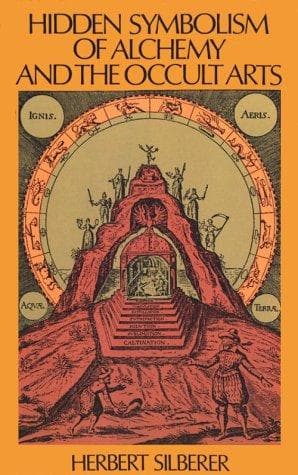
Hidden Symbolism of Alchemy and the Occult ArtsSilberer, Herbert
Religion
Hidden Symbolism of Alchemy and the Occult Arts
Silberer, Herbert
Alchemy; Society of Rosicrucians; Symbolism (Psychology)
It is also conceivable that the obtrusive occurrence of incest, castration
of the father, etc., should make the mythologists ponder. It was bias on
the part of many of them to be unwilling to see the psychological value of
these things. I must therefore acknowledge the justice of Rank’s view when
he (Inz-Mot., p. 278) says in reference to the Œdipus myth (rightly, in
all probability, interpreted by Goldziher as a sun myth): “Yet it is
indubitable that these ideas of incest with the mother and the murder of
the father are derived from human life, and that the myth in this human
disguise could never be brought down from heaven without a corresponding
psychic idea, which may really have been an unconscious one even at the
time of the formation of the myth, just as it is with the mythologists of
today.”
And in another passage (pp. 318 ff.): “While these investigators (astral
and moon mythologists) would consider incest and castration operative in
an equal or even greater degree than we do, as the chief motives in the
formation of myths in the celestial examples only, we are forced by
psychoanalytical considerations to find in them universal primitive human
purposes which later, as a result of the need of psychological
justification, have been projected into the heavens from which our myth
interpreters wish in turn to derive them. [Whether such a need of
justification has had a share in the formation of myths appears to me
doubtful or at any rate not demonstrable. At all events in so strongly
emphasizing these unnecessary assumptions and conceiving the projection
upon heaven of the mundane psychological primal motives as an act of
release, we hide the more important cause for concerning ourselves with
heaven, namely the already mentioned vital importance of the things that
are accomplished there. Now the fact that the primal motives cooperate in
the symbolical realization of these things, implies no defense directed
against them. A better defense would be to repress them in symbolism than,
as really happens, to utilize them in it.] These interpreters, for
example, have believed that they recognized in the motive of dismemberment
(castration) a symbolic suggestion of the gradual waning of the moon,
while the reverse is for us undoubted, namely, that the offensive
castration has found a later symbolization in the moon phases. Yet it
argues either against all logic and psychology, or for our conception of
the sexualization of the universe, that man should have symbolized so
harmless a phenomenon as the changes of the moon, by so offensive a one as
the dismemberment or castration of the nearest relative. So the nature
mythologists also, and Siecke in particular, have thought that primitive
man has ‘immediately regarded’ the (to him) incomprehensible waning of the
moon as a dismemberment, while this is psychologically quite unthinkable
unless this image, which is taken from earthly life, should have likewise
Public-domain text, read in full here on John Shaqi.
Reviews
Reviews
No reviews yet
Be the first to share your thoughts on this work.
Elsewhere in the archive
Join the Discussion
Join the discussion
Sign in to leave a comment or review.
Sign InorCreate an account