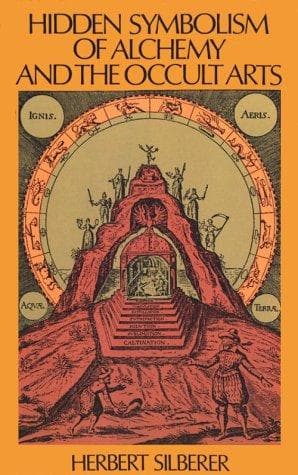
Hidden Symbolism of Alchemy and the Occult ArtsSilberer, Herbert
Religion
Hidden Symbolism of Alchemy and the Occult Arts
Silberer, Herbert
Alchemy; Society of Rosicrucians; Symbolism (Psychology)
It is quite suggestive to associate the anagogic idea of the _Unio
mystica_, precisely on account of the erotic allegory, with the primal
motive of sexual union (with the mother) instead of with the wish to die,
as I have done at another place. It may be that the primal erotic power
supplies something for the accomplishment of this last purpose; it may be
that all powers must coöperate. If I now still abide by my original
exposition, this happens because it appears to me that the symbolism
emphasizes the going over of the one into the other more than the
attainment of the sexual goal; and even in the cases where the unio
mystica is described as a sexual union. We should not forget that the
sexual gratification is to be regarded also as a kind of annihilation. It
is a condition of intoxication and of oblivion or perishing. It is this
side of the sexual procedure that the symbolism of the unio mystica
particularly emphasizes.
Brhadaranyaka-Upanisad, IV, 3, 21: “... For even as one embraced by a
beloved woman has no consciousness of what is within or without, so the
spirit, embraced by the most percipient self (prajena almana, i.e., the
Brahm), has no knowledge of that which is external or internal. That is
its form of existence, in which it is characterized by stilled desire,
even its own desire is without desire and separated from sorrow.” This
passage treats of the deep sleep (susupti) which is regarded as a passing
union with the highest spirit, and so, as essentially the same as the
definitive _unificatio_. Sleep is the brother of death. Susupti is,
furthermore, conceived only as a preliminary; a German mystic would call
it a foretaste of the definitive ascent into Brahm.
In the parable the unio mystica appears twice represented, once in that
the king and queen are represented as the bridal couple, and the second
time when the king, i.e., God, takes the wanderer up into his kingdom.
The attainment of an inner harmony, of a serene peace, is what, as it
seems to me, is most clearly brought out as the characteristic of the
final unificatio—not merely by the Hindus or Neoplatonists, but also by
the Christian mystics and by the alchemists.
Artephius is quoted by H. A., p. 86, as follows: “... This water [water of
life] causes the dead body to vegetate, increase and spring forth, and to
rise from death to life by being dissolved first, and then sublimed. And
in doing this the body is converted into a spirit, and the spirit
afterwards into a body; and then is effected the amity, the peace, the
concord and the union of the contraries.”
Similarly Ripley (H. A., p. 245): “This is the highest perfection to which
any sublunary body can be brought, by which we know that God is one, for
God is perfection; to which, whenever any creature arrives in its kind
[according to its nature], it rejoiceth in unity, in which there is no
division nor alterity, but peace and rest without contention.”
Public-domain text, read in full here on John Shaqi.
Reviews
Reviews
No reviews yet
Be the first to share your thoughts on this work.
Elsewhere in the archive
Join the Discussion
Join the discussion
Sign in to leave a comment or review.
Sign InorCreate an account