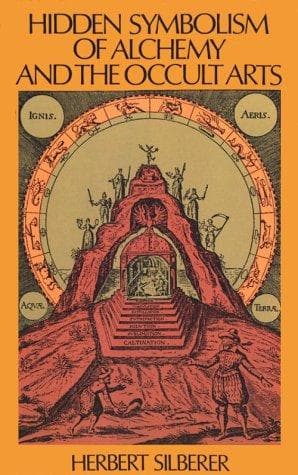
Hidden Symbolism of Alchemy and the Occult ArtsSilberer, Herbert
Religion
Hidden Symbolism of Alchemy and the Occult Arts
Silberer, Herbert
Alchemy; Society of Rosicrucians; Symbolism (Psychology)
The final character of the completed philosopher’s stone makes it
conceivable, that, as the hermetic masters say, it is made only once by a
man and then not again. The Stone is an absolutely imperishable Good; but
if it should be lost it is surely not the right stone.
I have now to offer some conjectures regarding further interpretations of
the two and the three principles [Symbol: Gold] and [Symbol: Silver],
namely [Symbol: Sulfur] [Symbol: Mercury] [Symbol: Salt]. We are aware of
a general difference. I add now first the remark of Hitchcock that the
“two” things are to be regarded as an antithesis: _natura naturans_ and
_natura naturata_. We might intellectually conceive the [Symbol: Mercury]
(mercury) given by many writers at the beginning of the work as a double
one, on the one hand as nature and on the other as our world picture. We
cause it to work on our [Symbol: Sulphur] (sulphur), i.e., on our
affectivity by which the [Symbol: Sulphur] is purified and dissolved, for
it is compelled to adapt itself to the requirements of the world laws. But
by this means a new world picture is produced, for the former had been
influenced by the unclarified [Symbol: Sulphur]; our affective life limits
our intellectual. The new world picture or the newly gained [Symbol:
Mercury] we combine with our [Symbol: Sulfur] and so on, until finally
after a gradual clarification nature and our world picture harmonize. Then
there are no longer two mercuries but only one; and the sulphur, our
completed subject, has become more or less a unity. Now we may advance to
the unification of the two clarified things, which in this stage are
called [Symbol: Gold] and [Symbol: Silver]. Now subject and object are
bound together and man enters, as is so wonderfully expressed in
Chandogya-Upanisad, VIII, 13, as a being adapted into the unadapted
(uncreated-primordial) world of Brahma. [Symbol: Sol] and [Symbol: Luna]
may, to be sure, be conceived also as the love of God towards man and the
love of man towards God. The different masters of the art are the same in
different ways in that the one sees more the intellectual, the other the
emotional. They describe different sides or aspects of the same process,
for which we do not indeed possess appropriate concepts, and whose best
form of expression is through symbols. The sign [Symbol: Sol] is then
neither = subject nor love but just = [Symbol: Sol], i.e., a thing to
which we may approximate nearest by a form of integration of all partial
meanings. In view of the fact that [Symbol: Sulfur] and [Symbol: Mercury]
are contrasted at the beginning of the process also as body and soul, we
can, by making [Symbol: Sulfur] = passions and [Symbol: Mercury] =
knowledge (reason) conceive the rest thus: [Symbol: Sulfur] is to be
purified by an exalted [Symbol: Mercury] (in distinction from the common
[Symbol: Mercury], called also “our” [Symbol: Mercury]), and so to be
purified by a higher knowledge. From [Symbol: Sulfur] is developed (i.e.,
Public-domain text, read in full here on John Shaqi.
Reviews
Reviews
No reviews yet
Be the first to share your thoughts on this work.
Elsewhere in the archive
Join the Discussion
Join the discussion
Sign in to leave a comment or review.
Sign InorCreate an account