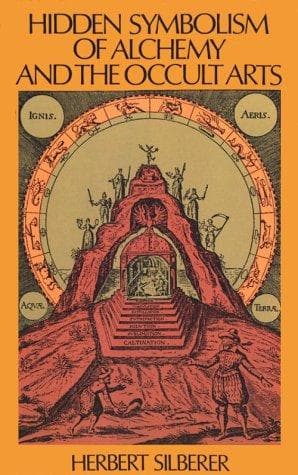
Hidden Symbolism of Alchemy and the Occult ArtsSilberer, Herbert
Religion
Hidden Symbolism of Alchemy and the Occult Arts
Silberer, Herbert
Alchemy; Society of Rosicrucians; Symbolism (Psychology)
These typical groups of symbols that the mystic [I draw a certain
distinction between the mystes and the mystic. The latter is a mystes who
makes a system of what he has realized.] produces as a functional
expression of his subjective transformation, can be thought of as an
educational method applied to arouse the same reactions in other men. In
the group of symbols are contained more or less clearly the already
mentioned elementary types as they are common to all men; they strike the
same chords in all men. Symbolism is for this very reason the most
universal language that can be conceived. It is also the only language
that is adapted to the various degrees of intensity as well as to the
different levels of the intro-determination of living experience without
requiring therefore a different means of expression; for what it contains
and works with are the elementary types themselves [or symbols which are
as adequate as possible to them] which, as we have seen, represent a
permanent element in the stream of change. This series of symbols is quite
as useful to the neophyte as to the one who is near to perfection; every
one will find in the symbols something that touches him closely; and what
must be particularly emphasized is that the individual at every spiritual
advance that he makes, will always find something new in the symbols
already familiar to him, and therefore something to learn. To be sure,
this new revelation is founded in himself; but there results for the
uncritical mind (mythological level) the illusion that the symbols (e.g.,
those of the holy scripture) are endowed with a miraculous power which
implies a divine revelation. [Cf. the concept of the origin of the symbol
in my essay, Phant. u. Myth.] Because of a similar illusion, e.g.,
Jamblichus posits demons between gods and men, who make comprehensible to
the latter the utterances of the gods; the demons, he thinks, are servants
of the gods and execute their will. They make visible to men in works and
words the invisible and inexpressible things of the gods; the formless
they reveal in forms and they reveal in concepts what transcends all
concepts. From the gods they receive all the good of which they are
capable, partially or according to their nature, and share it again with
the races that stand below them.
Public-domain text, read in full here on John Shaqi.
Reviews
Reviews
No reviews yet
Be the first to share your thoughts on this work.
Elsewhere in the archive
Join the Discussion
Join the discussion
Sign in to leave a comment or review.
Sign InorCreate an account