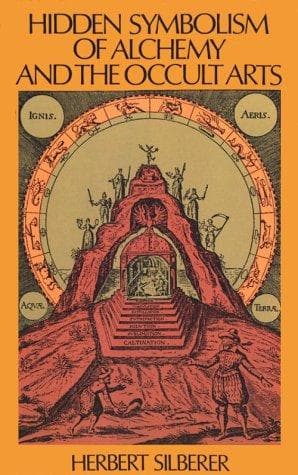
Hidden Symbolism of Alchemy and the Occult ArtsSilberer, Herbert
Religion
Hidden Symbolism of Alchemy and the Occult Arts
Silberer, Herbert
Alchemy; Society of Rosicrucians; Symbolism (Psychology)
I said above, every one will find something appropriate to himself in the
symbols, and I emphasized the great constancy of the types fast rooted in
the unconscious, types which impart to them a universal validity. The
divine is revealed “only objectively different according to the
disposition of the vessel into which it falls, to one one way, another to
another. To the rich poetical genius it is revealed preeminently in the
activity of his imagination; to the philosophical understanding as the
scheme of a harmonious system. It sinks into the depths of the soul of the
religious, and exalts the strong constructive will like a divine power.
And so the divine is honored differently by each one.” (Ennemoser, Gesch.
d. M., p. 109.) “The spiritual element of the inheritance handed down by
our fathers works out vigorously in the once for all established style....
On the dark background of the soul stand, as it were, the magic symbols in
definite types, and it requires but an inner or outer touch [E.g., by
religious observances.] to make them kindle and become active.” (Ib., p.
274.) “The unconscious is common to all mankind in an infinitely greater
degree than the content of the individual consciousness, for it is the
condensation of the historically average and oft-repeated.” (Jung, Jb. ps.
F., III, pp. 169 ff.)
Whoever allows the educative symbols to work upon him, whether he sees
only darkly the ethical applications typified in them, or clearly
perceives them, or completely realizes them in himself, in any case he
will be able to enjoy a satisfying sense of purification for his earnest
endeavor in an ethical direction. The just mentioned dim perception
(probably the most frequent case), does not exclude the existence of very
clear ideas in consciousness; the person in question generally considers
his ideas, although they are only masks in front of the absolute ideal, as
the ultimate sense of the symbol, thus accepting one degree of
significance for the complete meaning. Every one approximates the ideal as
he can; the absolute ideal through his ephemeral, but attainable ideal.
The highest being speaks in the inexhaustible Bhagavad-Gita:
“More trouble have they who devote themselves to the invisible;
By physical beings the invisible goal is attained only with
difficulty.
[XII, 5.]
Public-domain text, read in full here on John Shaqi.
Reviews
Reviews
No reviews yet
Be the first to share your thoughts on this work.
Elsewhere in the archive
Join the Discussion
Join the discussion
Sign in to leave a comment or review.
Sign InorCreate an account