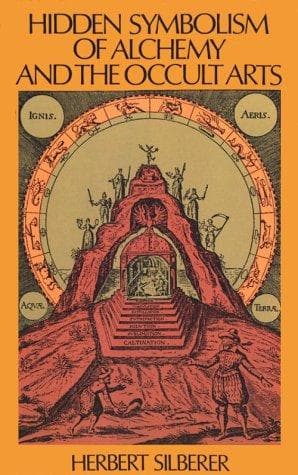
Hidden Symbolism of Alchemy and the Occult ArtsSilberer, Herbert
Religion
Hidden Symbolism of Alchemy and the Occult Arts
Silberer, Herbert
Alchemy; Society of Rosicrucians; Symbolism (Psychology)
In regard to the high ethical aspirations of alchemy, we understand that
as a mystic art it preserves those attributes of a royal art which it
seems to have had at first merely as gold making and magic. In fact what
art may more justly be called royal than that of the perfection of
mankind, that art which turns the dependent into the independent, the
slave into a master? The freeing of the will in the mystic (and in every
ethical) process has already, I believe, been commented on enough to be
comprehensible. And the power of rule that has been extolled as a magical
effect of the Philosopher’s Stone lies in the harmonizing of the
individual will with that of the world or with God’s will. In the new
birth—so remarks Jane Leade casually—we acquire a magic power; this occurs
“through faith, that is, through the harmony of our will with the divine
will. For faith puts the world in our power, inasmuch as the harmony of
our will with the divine has the result of making everything ours or
obedient to us. The will of the soul, when it accords wholly with the
divine, is no longer a naked will lacking its raiment, power, but brings
with it an invincible omnipotence.”
To-day, too, there is a royal art. Freemasonry bears this name. Not only
the name but its ethical ideal connects it with the spirit of the old
alchemy. This statement will probably be contradicted and meet the same
denial as did once the ideas of Kernning [J. Krebs], although I think I am
on different ground from that of this poetic but, in my eyes, all too
uncritical author. Keep in mind the historical treatment mentioned in Part
I, Section 4, and furthermore do not forget the psychological basis of our
present modes of viewing things.
[If I wished to compare the ethical aims of both in general terms, I
should run the risk of unduly expatiating on what is easily understood.
Robert Fischer describes freemasonry as a society of men who have set
themselves the severe task of a wise life and labor as the most difficult
task, of self-knowledge, self-mastery and self-improvement,—tasks that are
not finished in this life but only through death prepare us for the stage
where the true consummation begins. These beautiful and straightforward
words could just as well stand in an alchemistic discussion on the
terrestrial and celestial. But this will suffice.]
And now permit me to present the following portrayals by Jane Leade
[English mystic of the 17th century. She belonged to the philadelphian
society founded by Pordage.] which I reproduce here with a few words of
comment, and take them as an illustration of the beautiful spiritual union
of the serious hermetic with the new royal art. The reader can draw his
own conclusions. The passages are taken from Leade’s “Garten-Brunn” (L. G.
B.). References to Wirth are to the “Symbolisme Hermétique” (W. S. H.) of
this modern author.
Public-domain text, read in full here on John Shaqi.
Reviews
Reviews
No reviews yet
Be the first to share your thoughts on this work.
Elsewhere in the archive
Join the Discussion
Join the discussion
Sign in to leave a comment or review.
Sign InorCreate an account