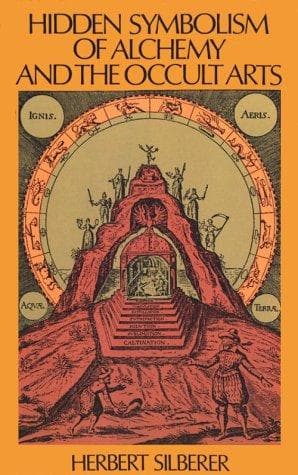
Hidden Symbolism of Alchemy and the Occult ArtsSilberer, Herbert
Religion
Hidden Symbolism of Alchemy and the Occult Arts
Silberer, Herbert
Alchemy; Society of Rosicrucians; Symbolism (Psychology)
God is the all. Hard is it to find the noble man who recognizes
this.
Those whom greed robs of knowledge go to other gods,
Cleave to many rulers—their own nature rules them,
And whatsoever divinity one strives to honor in belief,
I respect his belief and direct him to the right place.
If he strives in firm belief towards his divinity’s favor and
grace,
Then shall he in part get what he wants, for I gladly put good in
his way.
Yet the result is but limited in the case of those of limited
sensibility.
He finds the gods who honors them. Who honors me, attains to me.”
[VII, 19-23.]
If above I derived the instructive group of symbols from a mystic, that is
not to say that it must be precisely so. I brought out this case among
possible cases only for the reason that the mystic is the one who carries
out most strenuously the ethical work of purification, and under such
conditions as are most favorable to a suggestive group of symbols, and in
particular those rich in characteristic types. Bear in mind the founders
of religion. (They do not always have to be individuals—schools, myths.)
There are, however, others than the religiously inspired natures, who are
preëminently endowed to produce suggestive symbol groups with anagogic
value; the artists. I suspect that it would prove that the purifying
(cathartic) action of a work of art is the greater the more strongly the
anagogic symbolism (the groups of types that carry it) is developed, or in
other words, the more they express a tendency to a broadening of the
personality. This tendency, to which belong the motives of the denial of
the selfish will (father figure) of the love that is connected with
sacrifice (incest motive, regeneration) of the devotion to an ideal
(longing for death), etc., is manifested in the artist as also in the
devout observer of the work of art in his very devotion to it. Being lost
in a work of art appears to me essentially related both to introversion
and to the unio mystica.
I have already spoken of the creations of the myth forming imagination and
its anagogic import. In alchemy, to which I wish now to return, the
mythical and the individual images meet in the most vivid way, without
destroying each other.
Public-domain text, read in full here on John Shaqi.
Reviews
Reviews
No reviews yet
Be the first to share your thoughts on this work.
Elsewhere in the archive
Join the Discussion
Join the discussion
Sign in to leave a comment or review.
Sign InorCreate an account