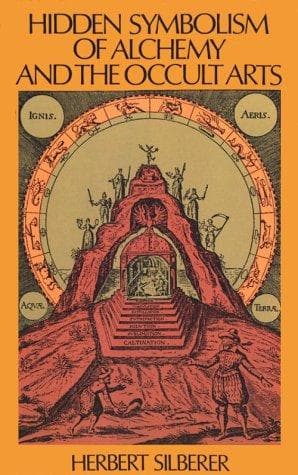
Hidden Symbolism of Alchemy and the Occult ArtsSilberer, Herbert
Religion
Hidden Symbolism of Alchemy and the Occult Arts
Silberer, Herbert
Alchemy; Society of Rosicrucians; Symbolism (Psychology)
Note H (381). For the old as for the new royal art the material is man, as
man freed from all framework. “Not man of the conventional social life,
but man as the equally entitled and equally obligated being of divine
creation, enters the temple of humanity with the obligation always to
remain conscious of his duty and to put aside everything that comes up to
hinder the fulfillment of the highest duty.” (R. Fischer.) Compare with
this what Hitchcock says of the material of the Philosopher’s Stone:
“Although men are of diverse dispositions ... yet the alchemists insist
... that all the nations of men are of one blood, that is, of one nature;
and that character in man, by which he is one nature, it is the special
object of alchemy to bring into life and action, by means of which, if it
could universally prevail, mankind would be constituted into a
brotherhood.” (H. A., pp. 48 ff.) [The tests] ... “begin with the
stripping of the metals. Now alchemy recommends, once the propitious
matter is seen, carefully examined and recognized, to clean it externally
for the purpose of freeing it of every foreign body that could adhere
accidentally to its surface. The matter, in fine, should be reduced to
itself. Now it is an absolutely analogous matter that the candidate is
called to strip himself of everything that he possesses artificially; both
it and he ought to be reduced strictly to themselves. In this state of
primitive innocence, of philosophic candor retrieved, the subject is
imprisoned in a narrow retreat where no external light can penetrate. This
is the chamber of meditation which corresponds to the matras of the
alchemist, to his philosophic egg hermetically sealed. The uninitiated
finds there a dark tomb where he must voluntarily die to his former
existence. By decomposing the integuments that are opposed to the true
expansion of the germ of individuality, this symbolic death precedes the
birth of the new being who is to be initiated.” (W. S. H., pp. 87 ff.)
Public-domain text, read in full here on John Shaqi.
Reviews
Reviews
No reviews yet
Be the first to share your thoughts on this work.
Elsewhere in the archive
Join the Discussion
Join the discussion
Sign in to leave a comment or review.
Sign InorCreate an account