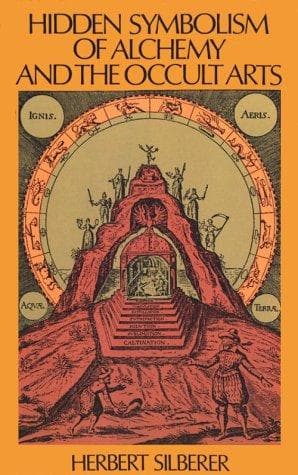
Hidden Symbolism of Alchemy and the Occult ArtsSilberer, Herbert
Religion
Hidden Symbolism of Alchemy and the Occult Arts
Silberer, Herbert
Alchemy; Society of Rosicrucians; Symbolism (Psychology)
Note I (411). As to the Chamber of the Companion hung in red, it
represents the sphere of action of our individuality, measured by the
extent of our sulphurous radiation. This radiation produces a kind of
refractive [refringent] medium, which refracts the surrounding diffused
light [[Symbol: Mercury] is meant] to concentrate it on the spiritual
nucleus of the subject. Such is the mechanism of the illumination, by
which those benefit who have seen the blazing star shine. Every being
bears in himself this mysterious star, but too often in the condition of a
dim spark hardly perceptible. It is the philosophic child, the immanent
Logos or the Christ incarnate, which legend represents as born obscurely
in the midst of the filth of a cave serving as a stable. The initiation
becomes the vestal of this inner fire [Symbol: Sulfur]; archetype or
principle of all individuality. She knows how to care for it as long as it
is brooded in the ashes. Then she devotes herself to nourishing it
judiciously, to render it keen for the moment when it finally should
overcome the obstacles that imprison it and seek to hold it in isolation.
It means, as a matter of fact, that the Son is put en rapport with the
external [Symbol: Mercury], or in other words, that the individual enters
into communion with the collectivity from which he comes.
BIBLIOGRAPHY.
OLD. (Before 1800.)
Agrippa ab Nettesheym, Henricus Cornelius, Opera.
Alchemisten, Griechische, v. Berthelot, Hoefer (moderne).
“Allgemeine (und General-) Reformation der gantzen (weiten) Welt” vide
“Fama.”
“Amor proximi” (“Das Buch Amor Proximi Geflossen aus dem Oehl der
Göttlichen Barmhertzigkeit ...”) Ans tag-licht gegeben per Anonymum.
Franckfurt und Leipzig, 1746.
(Andreae, Valentin) Anonym, Chymische Hochzeit Christiani Rosencreutz.
Anno 1459. Gedruckt zuerst zu Strassburg bey Lazari Zetzners seel. Erben
MDCXVI. Regenspurg, MDCCLXXXI (eigentlich Berlin, bei Nicolai).
Arabi v. Horten (mod.).
Arnaldus de Villa Nova, Chymische Schrifften. Aus dem Latein übersetzet
durch Joh. Hoppodamum. Frankfurt und Hamburg, 1683.
Bādarāyana v. Deussen (mod.).
Basile, Giambattista v. mod.
“Bauer” (“Der grosse und der kleine Bauer”). Zwey Philosophische und
Chymische Tractate. Leipzig, 1744.
Beaumont, Iohann, Historisch-Physiologisch- und Theologischer Tractat von
Geistern. Aus der Englischen Sprache in die Teutsche mit Fleiss übersetzt
von Theodor Arnold. Halle im Magdeburgischen, 1721.
Bekker, Balthasar, Die Bezauberte Welt. Amsterdam, 1693.
Bernhard, Graf von der Mark und Tervis, Abhandlung von der Natur des
(philosophischen) Eyes. Hildesheim, 1780.
“Bhagavad-Gîtā” v. Schlegel, Schroeder (mod.).
Boehme, Jacob, Schriften. Gesammtausgabe von Johan Georg Gichtel. 2 Bde.
1715.
Bonaventura, Opera.
Booz, Ada Mah (Dr. Adam Michael Birkholz), Die sieben heiligen Grundsäulen
der Ewigkeit und Zeit. Leipzig, 1783.
“Confessio” (der Fraternität R. C.) v. “Fama.”
Public-domain text, read in full here on John Shaqi.
Reviews
Reviews
No reviews yet
Be the first to share your thoughts on this work.
Elsewhere in the archive
Join the Discussion
Join the discussion
Sign in to leave a comment or review.
Sign InorCreate an account