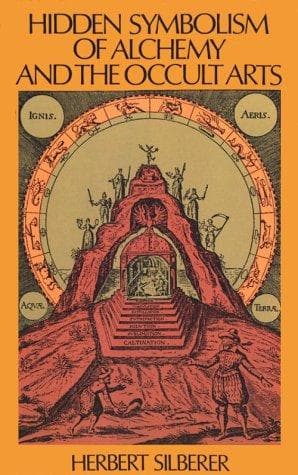
Hidden Symbolism of Alchemy and the Occult ArtsSilberer, Herbert
Religion
Hidden Symbolism of Alchemy and the Occult Arts
Silberer, Herbert
Alchemy; Society of Rosicrucians; Symbolism (Psychology)
Dismemberments in creation myths are not always multiple but sometimes
dichotomous. Thus in the Babylonian cosmogony Marduk splits the monster
Tiamat into two pieces, which henceforth become the upper and lower half
of heaven. Winckler concludes that Tiamat is man-woman (primal pair). This
brings us to the type of creation saga where the producer of the
(improved) world separates the primal pair, his parents. The Chinese
creation myth speaks of the archaic Chaos as an effervescing water, in
which the two powers, Yang (heaven) and Yin (earth), the two primal
ancestors, are mingled and united. Pwanku, an offshoot of these primal
powers (son of the parents), separates them and thus they become manifest.
In the Egyptian myth we read (in Maspero, Histoire des Peuples de
l’Orient, Stucken, Astral Myth, p. 203): “The earth and the heaven were in
the beginning a pair of lovers lost in the Now who held each other in
close embrace, the god below the goddess. Now on the day of creation a new
god [son type], Shou, came out of the eternal waters, glided between them
and seizing Nouit [the goddess] with his hands, lifted her at arms’ length
above his head. While the starry bust of the goddess was lengthened out in
space, the head to the west, the loins to the east, and became the sky,
her feet and her hands [as the four pillars of heaven] fell here and there
on our earth.” The young god or the son pushes his way between the
parents, sunders their union, just as the dreamer Omicron would have liked
to sunder the chain of the bear (the marriage bond of the parents). This
case is quite as frequent a type in analytic psychology as in mythical
cosmology. The child is actually an intruder, even if it does indirectly
draw the bonds of marriage tighter. Fundamentally regarded, the child
appears as the rival of the father, who is no longer the only beloved one
of his wife. He must share the love with the new comer, to whom an even
greater tenderness is shown. Regarded from the standpoint of the growing
son, the intrusion represents the Œdipus motive (with the incest wish).
The most outspoken and also a commonly occurring form of the mythological
separation of the primal pair is the castration of the father by the son.
The motive is, according to all accounts, psychologically quite as
comprehensible as the frequently substituted castration of the son by the
father. The latter is psychologically the necessary correlate of the first
form. The rivals, father and son, menace each other’s sexual life. That
the castration motive works out that way with father and son (son-in-law
if the daughter takes the place of the mother) is expressed either in so
many words in the myth or through corresponding displacement types.
Public-domain text, read in full here on John Shaqi.
Reviews
Reviews
No reviews yet
Be the first to share your thoughts on this work.
Join the Discussion
Join the discussion
Sign in to leave a comment or review.
Sign InorCreate an account