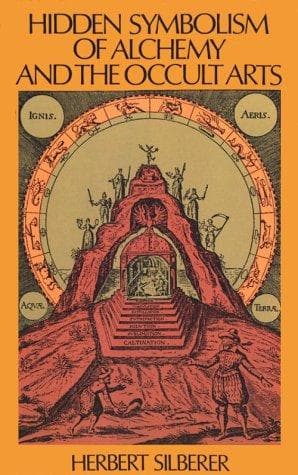
Hidden Symbolism of Alchemy and the Occult ArtsSilberer, Herbert
Religion
Hidden Symbolism of Alchemy and the Occult Arts
Silberer, Herbert
Alchemy; Society of Rosicrucians; Symbolism (Psychology)
In Section 18, “the sun shines very bright, and the day becomes warmer
than before and the dog days are at hand.” Soon after (Sec. 19) the king
is released from prison. It was before the winter (Sec. 14), but after
that season, when the sun “shines very warm” (Sec. 11), consequently well
advanced into autumn. Let us choose for the purpose a middle point between
the departing summer and the approaching winter, about the end of October,
and bear in mind that the dog-days come in August, so that at the end of
July they are in waiting, then we find for the time spent in the
receptacle nine months—the time of human gestation.
The newborn (Sec. 20) is naturally—thirsty. What shall he be fed with if
not with the water from the mill? And the water makes him grow and thrive.
Two royal personages stand before us in splendor and magnificence. The
wanderer has created for himself new parents (the father-king is, of
course, also himself) corresponding to the family romance of neurotics, a
phantasy romance, that like a ghost stalks even in the mental life of
healthy persons. It is a wish phantasy that culminates in its most
outspoken form in the conviction that one really springs from royal or
distinguished stock and has merely been found by the actual parents who do
not fit. They conceal his true origin. The day will come, however, when he
will be restored to the noble station which belongs to him by right. Here
belong in brief, those unrestrained wish phantasies which, no matter in
what concrete form, diversify the naïvely outlined content. They arise
from dissatisfaction with surroundings and afford the most agreeable
contrasts to straitened circumstances or poverty. In the parable
especially, the King (in his father character) is attractively portrayed.
At first the “lofty appearance” (Sec. 19) of the severe father amazes the
wanderer, then it turns out, however, that the king (ideal father) is
friendly, gracious and meek, and we are assured that “nothing graces
exalted persons as much as these virtues.” And then he leads the wanderer
into his kingdom and allows him to enjoy all the merely earthly treasures.
There takes place, so to speak, a universal gratification of all wishes.
Mythologically we should expect that the hero thrown up from the
underworld, should have brought with him the drink of knowledge. This is
actually the case, as he has indeed gained the thing whose constitution is
metaphorically worked out in the whole story, that is, the philosopher’s
stone. The wanderer is a true soma robber.
Public-domain text, read in full here on John Shaqi.
Reviews
Reviews
No reviews yet
Be the first to share your thoughts on this work.
Elsewhere in the archive
Join the Discussion
Join the discussion
Sign in to leave a comment or review.
Sign InorCreate an account