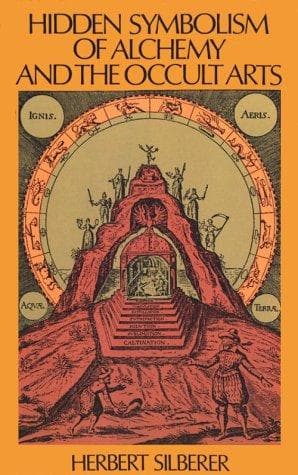
Hidden Symbolism of Alchemy and the Occult ArtsSilberer, Herbert
Religion
Hidden Symbolism of Alchemy and the Occult Arts
Silberer, Herbert
Alchemy; Society of Rosicrucians; Symbolism (Psychology)
Let us hark back to the next to last section. Here, near the end of the
dream, the King becomes sleepy. The real sleeper already feels the
approaching awakening and would like to sleep longer (to phantasy). But he
pretends that the king is sleepy, thus throwing the burden from his own
shoulders. And to this experience is soon attached a symbol of waking: the
wanderer, the dreamer of the parable, is taken to another land, indeed
into a bright land. He wakes from his dreams with a pious echo of his wish
fulfillment on his lips ... “to which end help us, the Father, Son, and
Holy Ghost, Amen.” It is quite prosaic to conclude this melodious finale
by means of the formula “threshold symbolism.”
To sum up in a few words what the parable contains from the psychoanalytic
point of view, and to do this without becoming too general in suggesting
as its results the universal fulfillment of all wishes, I should put it
thus: the wanderer in his phantasy removes and improves the father, wins
the mother, procreates himself with her, enjoys her love even in the womb
and satisfies besides his infantile curiosity while observing procreative
process from the outside. He becomes King and attains power and
magnificence, even superhuman abilities.
Possibly one may be surprised at so much absurdity. One should reflect,
however, that those unconscious titanic powers of imagination that, from
the innermost recesses of the soul set in motion the blindly creating
dream phantasy, can only wish and do nothing but wish. They do not bother
about whether the wishes are sensible or absurd. Critical power does not
belong to them. This is the task of logical thinking as we consciously
exercise it, inasmuch as we observe the wishes rising from the darkness
and compare and weigh them according to teleological standards. The
unconsciously impelling affective life, however, desires blindly, and
troubles itself about nothing else.
Section II.
Alchemy.
The tradition of craftsmanship in metallurgy, an art that was practiced
from the earliest times, was during the speculative period of human
culture, saturated with philosophy. Especially was this the case in Egypt,
where metallurgy, as the source of royal riches and especially the methods
of gold mining and extraction, were guarded as a royal secret. In the
Hellenistic period the art of metal working, knowledge of which has spread
abroad and in which the interest had been raised to almost scientific
character, was penetrated by the philosophical theories of the Greeks: the
element and atom ideas of the nature-philosophers and of Plato and of
Aristotle, and the religious views of the neoplatonists. The magic of the
orient was amalgamated with it, Christian elements were added—in brief,
the content of the chemistry of that time, which mainly had metallurgy as
its starting point, took a vital part in the hybrid thought of syncretism
in the first centuries after Christ.
Public-domain text, read in full here on John Shaqi.
Reviews
Reviews
No reviews yet
Be the first to share your thoughts on this work.
Elsewhere in the archive
Join the Discussion
Join the discussion
Sign in to leave a comment or review.
Sign InorCreate an account