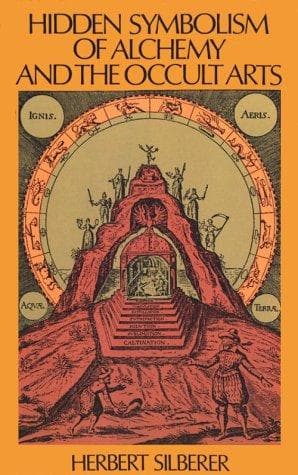
Hidden Symbolism of Alchemy and the Occult ArtsSilberer, Herbert
Religion
Hidden Symbolism of Alchemy and the Occult Arts
Silberer, Herbert
Alchemy; Society of Rosicrucians; Symbolism (Psychology)
It will not be superfluous to mention here, that the so-called materials,
substances, concepts, are found employed in the treatises of the
alchemists in a more comprehensive sense, we can even say with more lofty
implications, the more the author in question leans to philosophical
speculation. The authors who indulged the loftiest flights were indeed
most treasured by the alchemists and prized as the greatest masters. With
them the concept mercury, as element concept, is actually separated from
that of common quicksilver. On this level of speculation, quicksilver
(Hg.) is no longer considered as a primal element, but as a suprasensible
principle to which only the name of quicksilver, mercury, is loaned. It is
emphasized that the _mercurius philosophorum_ may not be substituted for
common quicksilver. Similar transmutations are effected by the concept of
a primal element specially separated from mercury. Prima materia is the
cause of all objects. Also the material from which the philosopher’s stone
is produced is in later times called the prima materia, accordingly in a
certain sense, the raw material (materia cruda) for its production. But I
anticipate; this belongs properly to the occidental flourishing period of
the alchemy of scholasticism.
A very significant and ancient idea in alchemy is that of sprouting and
procreation. Metals grow like plants, and reproduce like animals. We are
assured by the adepts (those who had found it, viz., the panacea) in the
Greek-Egyptian period and also later, that gold begets gold as the corn
does corn, and man, man. The practice connected with this idea consists in
putting some gold in the mixture that is to be transmuted. The gold
dissolves like a seed in it and is to produce the fruit, gold. The gold
ingredient was also conceived as a ferment, which permeates the whole
mixture like a leaven, and, as it were, made it ferment into gold.
Furthermore, the tincturing matter was conceived as male and the matter to
be colored as female. Keeping in view the symbol of the corn and seed, we
see that the matter into which the seed was put becomes earth and mother,
in which it will germinate in order to come to fruition.
In this connection belongs also the ancient alchemic symbol of the
philosopher’s egg. This symbol is compared to the “Egyptian stone,” and
the dragon, which bites its tail; consequently the procreation symbol is
compared to an eternity or cycle symbol. The “Egyptian stone” is, however,
the philosopher’s stone or, by metonomy, the great work (magnum opus) of
its manufacture. The egg is the World Egg that recurs in so many world
cosmogonies. The grand mastery refers usually and mainly to thoughts of
world creation. The egg-shaped receptacle in which the master work was to
be accomplished was also known as the “philosophical egg” in which the
great masterpiece is produced. This vessel was sealed with the magic seal
of Hermes; therefore hermetically sealed.
Public-domain text, read in full here on John Shaqi.
Reviews
Reviews
No reviews yet
Be the first to share your thoughts on this work.
Elsewhere in the archive
Join the Discussion
Join the discussion
Sign in to leave a comment or review.
Sign InorCreate an account