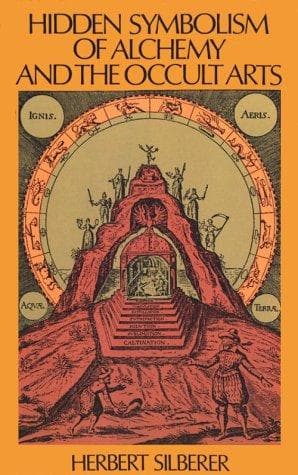
Hidden Symbolism of Alchemy and the Occult ArtsSilberer, Herbert
Religion
Hidden Symbolism of Alchemy and the Occult Arts
Silberer, Herbert
Alchemy; Society of Rosicrucians; Symbolism (Psychology)
As the chemical science (in alchemy, alkimia, al is the Arabic article
prefixed to the Greek χημεία) has come to us from the Arabs (Syrians,
Jews, etc.) it was long believed that it had an Arabian origin. Yet it was
found later that the Arabs, while they added much of their own to it,
still were but the preservers of Greek-Hellenistic knowledge and we are
convinced that the alchemists were right when they indicated in their
traditions the legendary Egyptian Hermes as their ancestor. This legendary
personage is really the Egyptian god Thoth, who was identified with Hermes
in the time of the Ptolemies. He was honored as the Lord of the highest
wisdom and it was a favorite practice to assign to him the authorship of
philosophical and especially of theological works. Hermes’ congregations
were formed to practice the cult, and they had their special Hermes
literature.(2) In later times the divine, regal, Hermes figure was reduced
to that of a magician. When I speak, in what follows, of the hermetic
writings I mean (following the above mentioned traditions) the alchemic
writings, with, however, a qualification which will be mentioned later.
The idea of the production of gold was so dominant in alchemy that it was
actually spoken of as the gold maker’s art. It meant the ability to make
gold out of baser material, particularly out of other metals. The belief
in it and in the transmutability of matter was by no means absurd, but
rather it must be counted as a phase in the development of human thought.
As yet unacquainted with the modern doctrine of unchangeable elements they
could draw no other conclusion from the changes in matter which they daily
witnessed. If they prepared gold from ores or alloys, they thought they
had “made” it. By analogy with color changes (which they produced in
fabrics, glass, etc.) they could suppose that they had colored (tinctured)
the baser metals into gold.
Under philosophical influences the doctrine arose that metals, like human
beings, had body and soul, the soul being regarded as a finer form of
corporeality. They said that the soul or primitive stuff (prima materia)
was common to all metals, and in order to transmute one metal into another
they had to produce a tincture of its soul. In Egypt lead, under the name
Osiris, was thought to be the primitive base of metals; later when the
still more plastic quicksilver (mercury) was discovered, they regarded
this as the soul of metals. They thought they had to fix this volatile
soul by some medium in order to get a precious metal, silver, gold.
That problematic medium, which was to serve to tincture or transmute the
baser metal or its mercury to silver or gold, was called the Philosopher’s
stone. It had the power to make the sick (base) metal well (precious).
Here came in the idea of a universal medicine. Alchemy desired indeed to
produce in the Philosopher’s Stone a panacea that should free mankind of
all sufferings and make men young.
Public-domain text, read in full here on John Shaqi.
Reviews
Reviews
No reviews yet
Be the first to share your thoughts on this work.
Elsewhere in the archive
Join the Discussion
Join the discussion
Sign in to leave a comment or review.
Sign InorCreate an account