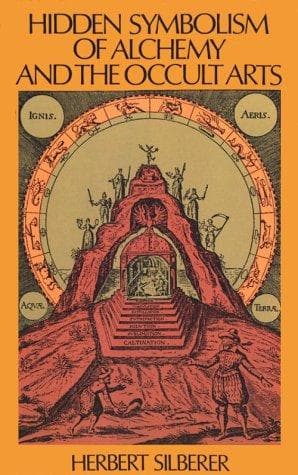
Hidden Symbolism of Alchemy and the Occult ArtsSilberer, Herbert
Religion
Hidden Symbolism of Alchemy and the Occult Arts
Silberer, Herbert
Alchemy; Society of Rosicrucians; Symbolism (Psychology)
Janus Lacinius gives in his Pretiosa Margarita the following allegory. In
the palace sits the king decorated with the diadem and in his hand the
scepter of the whole world. Before him appears his son with five servants
and falling at his feet implores him to give the kingdom to him and the
servants. [The author takes the thing wrong end to. The gold, king, is
assailed by the other six metals, because they themselves wish to be gold.
The king is killed. Essentially the same thing happens as above.] Then the
son in anger, and at the instigation of his companions, kills his father
on the throne. He collects the father’s blood in his garment. A grave [the
lion’s den, the grave] is dug, into which the son intends to throw the
father, but they both fall in. [Cf. the dangerous walk of the wanderer on
the wall, Section 8, where the people fall off.] The son makes every
effort to get out again, but some one comes who does not permit it.
[Symbolism of obstruction, the locked door, etc., in the parable. The
grave changes imperceptibly into the vessel where the bridal pair—with
Lacinius they are father and son instead of mother and son—are united and
securely locked in.] When the whole body is dissolved the bones are thrown
out of the grave. They are divided into nine [dismemberment], the
dissolved substance is cooked nine days over a gentle fire till the black
appears. Again it is cooked nine days until the water is bright and clear.
The black, with its water of life [in the parable the mill water is black]
is cooked nine days till the white earth of the philosophers appears. An
angel throws the bones on the purified and whitened earth, which is now
mixed with its seeds. They are separated from water in a strong fire.
Finally the earth of the bones becomes red like blood or ruby. Then the
king rises from his grave full of the grace of God, quite celestial, with
grand mien, to make all his servants kings. He places golden crowns on the
heads of his son and the servants.
As bearers of both seeds, male and female, the lion is androgynous.
Actually the subject (i.e., the first material) is conceived as twofold,
bisexual. It is called by names that mean the two sexes, it is also called
“hermaphrodite.” It is represented as rebis (res bina = double thing), as
a human with a male and a female head standing on a dragon. From the
conquered dragon (lion) comes forth the Double. The substance is also
called Mercurius; his staff bears the two antagonistic serpents mentioned
by Flamel. In the parable also appears an hermaphrodite, the being (Sec.
8) which the wanderer cannot distinguish, whether it be a man or a woman.
It is the original substance, Mercury, “our hermaphrodite.”
In Section 9 of the parable, and also later, red and white appear in
roses. The white and the red tincture are often in alchemy compared to
white and red roses.
Public-domain text, read in full here on John Shaqi.
Reviews
Reviews
No reviews yet
Be the first to share your thoughts on this work.
Elsewhere in the archive
Join the Discussion
Join the discussion
Sign in to leave a comment or review.
Sign InorCreate an account