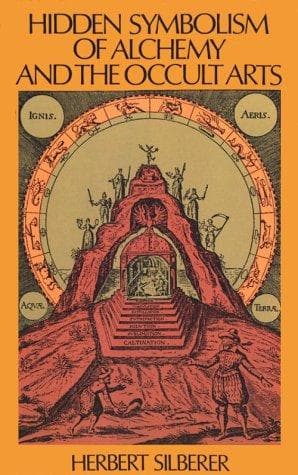
Hidden Symbolism of Alchemy and the Occult ArtsSilberer, Herbert
Religion
Hidden Symbolism of Alchemy and the Occult Arts
Silberer, Herbert
Alchemy; Society of Rosicrucians; Symbolism (Psychology)
In Section 9 the wanderer comes to those houses where people work alone or
by twos. They work in a slovenly fashion. The alchemistic quacks are
generally called “bunglers” and “messy cooks” by the masters of the art.
These are the ones who do not work according to the “possibilities of
nature,” which is, nevertheless, the touchstone of all right production.
The garden (Sec. 10, 11) is one of the “rose gardens” of which, e.g., the
alchemist, Michael Meier, likes to speak.
There are difficulties in uniting the red youths with the white maidens. A
wall separates them. The wanderer removes the obstruction in unlocking the
door. That may indicate a chemical unlocking, by which the bodies are
chemically brought nearer together.
The wanderer comes to a mill (Sec. 11). The mill naturally indicates the
already mentioned trituration of the substance. It has, however, also
reference to fermentation and in particular to that by means of meal.
Rulandus (Lex., pp. 211 ff., s. v. Fermentum): “Ferment is elixir, leaven,
or yeast as it is called; it makes porous the body that swells up and the
spirit finds a place in it so that it becomes fit to bake. As now the meal
is not yeast, but meal and water [mill water] and the whole dough is
thoroughly leavened and real yeast, so also the lapis [stone] is itself
the ferment, yet gold and mercury are also called ferment.”
Now begins the main work—marriage, prison, embrace, conception, birth,
transfiguration—to which the rest of the parable is devoted.
The prison is the philosophic egg. It is also called “Athanor, a sieve,
dunghill, bain-marie (double cooker), a kiln, round ball, green lion,
prison, grave, brothel, vial, cucurbit.” It is just like the belly and the
womb, containing in itself the true, natural warmth (to give life to our
young king). The warmth that is used must first be gentle, “like that
after the winter”; it must be stronger like the sun in spring, in summer
[cf. the seasons in our parable]. (Flamel, pp. 50 ff.)
Daustenius (Ros., VII): “... And this thing can be a symbol of a woman’s
belly, which, when she has conceived, will immediately close the womb.”
Id. (Ros., VII): “Therefore, when you have put them (the white woman and
the red man) in their vessel, then close it as fast as possible....” [Seal
of Hermes.]
Id. (Ros., VIII): “Therefore that you arrange the substances right and
fine, and regulate your work well, and marry consanguineous matter with
masses acting consanguineously....” [Incest.]
Id. (Ros., VII): “So now this is our solution, that you marry the Gabricum
with the Beja, which when he lies with the Beja, dies immediately and is
changed into her nature. Although the Beja is a woman, still she improves
the Gabricum because he is come out of her.” [Death of the bridegroom son.
It should be remembered in this connection that all metals or all
substances generally—consequently also the [Symbol: Sun]—come forth from
the “mother,” the primal substance [Symbol: Mercury].]
Public-domain text, read in full here on John Shaqi.
Reviews
Reviews
No reviews yet
Be the first to share your thoughts on this work.
Elsewhere in the archive
Join the Discussion
Join the discussion
Sign in to leave a comment or review.
Sign InorCreate an account