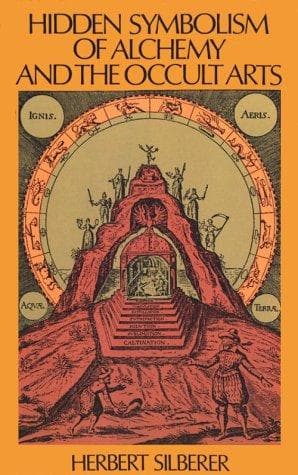
Hidden Symbolism of Alchemy and the Occult ArtsSilberer, Herbert
Religion
Hidden Symbolism of Alchemy and the Occult Arts
Silberer, Herbert
Alchemy; Society of Rosicrucians; Symbolism (Psychology)
Later he says (Id., XI): “Lay the son by her that she suckle him.” [The
water of life is therefore also the milk.]
The new king is born, and now he and his consort appear in priceless
garments (cf. Section 18 of the parable). The color change of the
substance is expressed by means of the change of garments, like peacock’s
tail, rainbow. The process goes from black through gray to white, yellow,
red, purple.
The end is reached with purple. The wanderer at the end describes the
virtues of the philosopher’s stone. We have already compared the great
elixir with soma. In the old alchemistic book, which bears the name of the
Persian magician, Osthanes (Berthelot, Orig., p. 52), the divine water
heals all maladies. Water of life,—elixir of life.
Many readers will shake their heads over the psychoanalytic exposition of
the parable. The gross development of sexuality and the Œdipus complex may
seem improbable to him. The alchemistic hieroglyphic has now in unexpected
manner shown after all, that these surprising things were not read into
the parable by psychoanalysis, but rightly found in it, even though
psychoanalysis has not by any means exhausted the contents of the parable.
What might at first have appeared to be bold conjecture, as for example,
killing of the father, incest with the mother, the conception of the red
blood and white bones as man and woman, the excrementitious substance as
procreative, the prison as the uterus, has all been shown to be in use as
favorite figurative expression among the alchemistic authors.
Public-domain text, read in full here on John Shaqi.
Reviews
Reviews
No reviews yet
Be the first to share your thoughts on this work.
Elsewhere in the archive
Join the Discussion
Join the discussion
Sign in to leave a comment or review.
Sign InorCreate an account