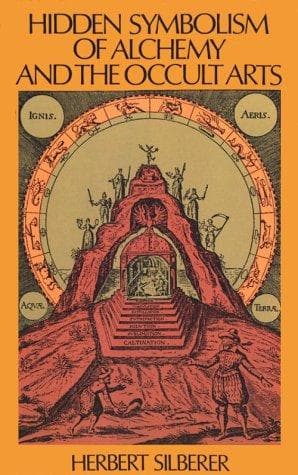
Hidden Symbolism of Alchemy and the Occult ArtsSilberer, Herbert
Religion
Hidden Symbolism of Alchemy and the Occult Arts
Silberer, Herbert
Alchemy; Society of Rosicrucians; Symbolism (Psychology)
The alchemists like to dwell on the process of procreation, and on
infantile sexual theories. The deep interest that they show in these
matters, and without which they would not have used them so much in their
hieroglyphics, the meaning that these things must have, in order to be
regarded as worthy to illustrate the processes of the great work, and
finally, the meaning that in some form or other they actually have in the
emotional life of every man, all of this makes it evident that the line of
imaginative speculations with which we have become acquainted, deserves
independent treatment. In practice there was a fission, and procreation
becomes an independent problem for alchemists. Yet the followers of the
art did learn from nature, in order that their art might follow the works
of nature even to improve on her; what wonder then if many of them set
themselves to the artificial creation—generation—of man? Yet the belief in
generatio equivoca has not long been dead. Must it not have seemed somehow
possible, in view of the supposed fact that they saw insects develop out
of earth, worms out of dung, etc., that they should by special artificial
interposition, be able to make higher forms of life come out of lifeless
matter? And of all the substances not one was indeed completely lifeless
for the “animated” metals even, grew and increased. In short, if we regard
the matter somewhat more closely, it is after all not so extraordinary
that they made serious attempts to create the homunculus.
Generally Paracelsus is regarded as the author of the idea, which to the
somewhat uncritical, could not, in my opinion, help being in the air.
There are different views regarding the part played by Paracelsus. The
instructions that he gives for the production of the homunculus are found
in a work (De natura rerum) whose authorship is not settled. And supposing
that Paracelsus was the writer, it must be considered whether he does not
lay before the inquisitive friend to whom the work is dedicated merely a
medley of oddities from the variegated store that he had collected from
all sources on his travels among vagrant folk. We must accept the facts as
we find them; the question as to whether it was Paracelsus or not would be
idle. Enough that there is a book by some writer who describes the work
and describes it in such a way that naïve scholarship could have thought
it quite consistent. The idea as such has appeared conceivable to us. Its
form in the book mentioned appears clearly determined by alchemistic
ideas. The reader will immediately perceive it himself as I give here some
passages from the book. (Cf. the Strassb. Folio Ausg. des Paracelsus, Vol.
I, pp. 881-884.) A consideration of the production of the homunculus
appears important to me because it shows the main content of alchemistic
ideas in enlarged form and complete development, a content that gives,
moreover, the very thing that psychoanalysis would here look for.
Public-domain text, read in full here on John Shaqi.
Reviews
Reviews
No reviews yet
Be the first to share your thoughts on this work.
Elsewhere in the archive
Join the Discussion
Join the discussion
Sign in to leave a comment or review.
Sign InorCreate an account