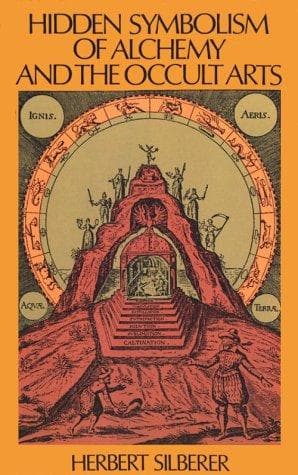
Hidden Symbolism of Alchemy and the Occult ArtsSilberer, Herbert
Religion
Hidden Symbolism of Alchemy and the Occult Arts
Silberer, Herbert
Alchemy; Society of Rosicrucians; Symbolism (Psychology)
Sun and gold are identical in the hieroglyphic mode of expression. Whoever
seeks only the chemical must therefore read: The work of gold, the
production of gold; and that is what thousands and millions have read. The
mere word gold was enough to make countless souls blind to everything
besides the gold recipe that might be found in the Smaragdine tablet. But
surely there were alchemistic masters who did not let themselves be
blinded by the word gold and sympathetically carried out still further the
language of the Smaragdine tablet. They were the previously mentioned
lofty-minded men. The covetous crowd of sloppers, however, adhered to the
gold of the Smaragdine tablet and other writings and had no appreciation
of anything else. For a long time alchemy meant no more for modern
historians.
The fact that modern chemical science is sprung from the hermetic
works,—as the only branch at present clearly visible and comprehensible of
this misty tree of knowledge,—has had for result that in looking back we
have received a false impression. Chemical specialists have made
researches in the hermetic art and have been caught just as completely in
the tangle of its hieroglyphics as were the blind seekers of gold before
them. The hermetic art, or alchemy in the wider sense, is not exclusively
limited to gold making or even to primitive chemistry. It should, however,
not be surprising to us who are acquainted with the philosophical
presuppositions of alchemy, that in addition to the chemical and
mechanical side of alchemy a philosophical and religious side also
received consideration and care. I think, however, that such historical
knowledge was not at all necessary to enable us to gather their pious
views from the religious language of many masters of the hermetic art.
However, this naïve childish logic was a closed book to the chemists who
made historical researches. They were hindered by their special knowledge.
It is far from my purpose to desire in the least to minimize the services
that a Chevreul or a Kopp has performed for the history of chemistry; what
I should like to draw attention to is merely that the honored fathers of
the history of chemistry saw only the lower—“inferius”—and not the
higher—“superius”—phase of alchemy, for example, in the Smaragdine tablet;
and that they used it as the type of universal judgment in such a way that
it needed a special faculty for discovery to reopen a fountain that had
been choked up.
I now realize that the poets have been more fortunate than the scientists.
Thus Wieland, who, for example, makes Theophron say in the Musarion (Book
II):
Public-domain text, read in full here on John Shaqi.
Reviews
Reviews
No reviews yet
Be the first to share your thoughts on this work.
Elsewhere in the archive
Join the Discussion
Join the discussion
Sign in to leave a comment or review.
Sign InorCreate an account