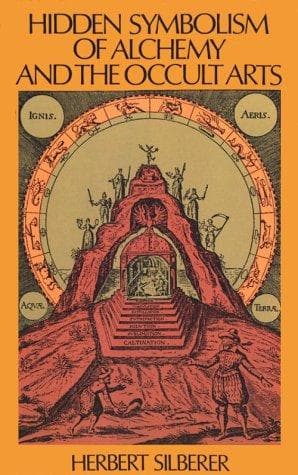
Hidden Symbolism of Alchemy and the Occult ArtsSilberer, Herbert
Religion
Hidden Symbolism of Alchemy and the Occult Arts
Silberer, Herbert
Alchemy; Society of Rosicrucians; Symbolism (Psychology)
Hitchcock (H. A., p. 42): “The ‘one’ thing of the alchemists is above all
man, according to his nature [as a nature] essentially and substantially
one. But if the authors refer to man phenomenally they speak of him under
different names, indicating different states as he is before or after
‘purification’ or they refer to his body, his soul or his spirit under
different names. Sometimes they speak of the whole man as mercury, ... and
then by the same word perhaps they speak of something special, as our
mercury which has besides, a multitude of other names ... although men are
of diverse dispositions and temperaments, some being angelic and others
satanic, yet the alchemists maintain with St. Paul that ‘all the nations
of men are of one blood,’ that is, of one nature. And it is that in man by
which he is of one nature which it is the special object of alchemy to
bring into life and activity; that by whose means, if it could universally
prevail, mankind would be constituted into a brotherhood.”
The alchemist says that a great difficulty at the outset of the work is
the finding or making of their necessarily indispensable mercury, which
they also call green lion, mercurius animatus, the serpent, the dragon,
acid water, vinegar, etc.
What is this mysterious mercury, susceptible to evolution, lying in
mankind, common to all, but differently worked out? Hitchcock answers,
conscience. Conscience is not equally “pure” with all men, and not equally
developed; the difficulty of discovering it, of which the alchemists tell,
is the difficulty of arousing it in the heart of man for the heart’s
improvement and elevation. The starting point in the education of man is
indeed to awaken in his heart an enduring, permanent sense of the
absolutely right, and the consistent purpose of adhering to this sense. It
is above all one of the hardest things in the world “to take a man in what
is called his natural state, St. Paul’s natural man, after he has been for
years in the indulgence of all his passions, having a view to the world,
to honors, pleasures, wealth, and make him sensible of the mere abstract
claims of right, and willing to relinquish one single passion in deference
to it.” Surely that is the one great task of the educator; if it be
accomplished, the work of improvement is easy and can properly be called
mere child’s play, as the hermetics like to call the later phases of their
work. (H. A., pp. 45 ff.)
Public-domain text, read in full here on John Shaqi.
Reviews
Reviews
No reviews yet
Be the first to share your thoughts on this work.
Elsewhere in the archive
Join the Discussion
Join the discussion
Sign in to leave a comment or review.
Sign InorCreate an account