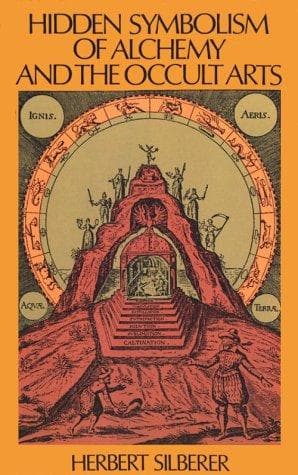
Hidden Symbolism of Alchemy and the Occult ArtsSilberer, Herbert
Religion
Hidden Symbolism of Alchemy and the Occult Arts
Silberer, Herbert
Alchemy; Society of Rosicrucians; Symbolism (Psychology)
The uninitiated read with amazement in many alchemists that “our
subjectum,” that is, the material to be worked upon, is also identical
with the vessel, the still, the philosopher’s egg, etc. That becomes
intelligible now. Hitchcock writes (H. A., p. 117) very pertinently: “The
work of the alchemists was one of contemplation and not a work of the
hands. Their alembic, furnace, cucurbit, retort, philosophical egg, etc.,
etc., in which the work of fermentation, distillation, extraction of
essences and spirits and the preparation of salts is said to have taken
place was Man,—yourself, friendly reader,—and if you will take yourself
into your own study and be candid and honest, acknowledging no other guide
or authority but Truth, you may easily discover something of hermetic
philosophy; and if at the beginning there should be ‘fear and trembling’
the end may be a more than compensating peace.”
The alchemist Alipili (H. A., p. 34) writes: “The highest wisdom consists
in this, for man to know himself, because in him God has placed his
eternal Word.... Therefore let the high inquirers and searchers into the
deep mysteries of nature learn first to know what they have in themselves,
and by the divine power within them let them first heal themselves and
transmute their own souls, ... if that which thou seekest thou findest not
within thee, thou wilt never find it without thee. If thou knowest not the
excellency of thine house, why dost thou seek and search after the
excellency of other things? The universal Orb of the world contains not so
great mysteries and excellences as does a little man formed by God in his
own image. And he who desires the primacy amongst the students of nature,
will nowhere find a greater or better field of study than himself.
Therefore will I here follow the example of the Egyptians and ... from
certain true experience proclaim, O Man, know thyself; in thee is hid the
treasure of treasures.”
A seminalist has concluded from this that the prima materia is semen, a
stercoralist, that it is dung.
George Ripley describes the subject of the philosopher’s stone as follows:
“For as of one mass was made the thing,
Right must it so in our praxis be,
All our secrets of one image must spring;
In philosophers’ books therefore who wishes may see,
Our stone is called the less-world, one and three.”
The stone is therefore the world in little, the microcosm, man; one, a
unity, three, [Symbol: Mercury] mercury, [Symbol: Sulphur] sulphur,
[Symbol: Salt] salt, or spirit, soul, body. Dichotomy also appears,
mercury and sulphur, which can then generally be rendered soul and body.
One author says, “We must choose such minerals as consist of a living
mercury and a living sulphur; work it gently, not with haste and hurry.”
[Cf. Tabula Smaragdina 9, “suaviter” ...]
Public-domain text, read in full here on John Shaqi.
Reviews
Reviews
No reviews yet
Be the first to share your thoughts on this work.
Elsewhere in the archive
Join the Discussion
Join the discussion
Sign in to leave a comment or review.
Sign InorCreate an account