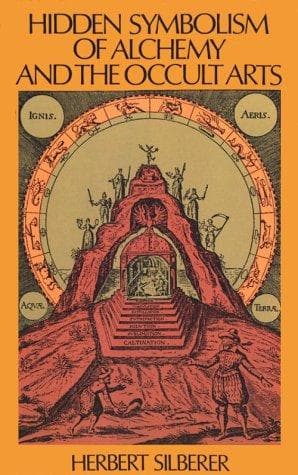
Hidden Symbolism of Alchemy and the Occult ArtsSilberer, Herbert
Religion
Hidden Symbolism of Alchemy and the Occult Arts
Silberer, Herbert
Alchemy; Society of Rosicrucians; Symbolism (Psychology)
Ephesians II, 14 ff.: “For he is our peace, who hath made both one, and
hath broken down the middle wall of partition between us, having abolished
in his flesh the enmity, even the law of commandments contained in
ordinances; for to make in himself of twain one new man, so making peace,
and that he might reconcile both unto God in one body by the cross, having
slain the enmity thereby.”
If we note the two contraries that are to be united according to the
procedure of the hermetic philosophers with [Symbol: Sun] and [Symbol:
Moon] [sun and moon, gold and silver, etc.] and represent them united with
the cross [Symbol: +] we get [Symbol: Mercury with a sun]; i.e., [Symbol:
Mercury], the symbol of mercury. This ideogram conceals the concept,
Easter. All these ideas, as we know, did not originate with Christianity.
II Corinthians V, 1: “For we know that if our earthly house of this
tabernacle were dissolved, we have a building of God, an house not made
with hands, eternal in the heavens.”
John VII, 38: “He that believeth on me ... out of his belly shall flow
rivers of living water.”
I mention right here that the hermetic philosophers do not pursue
speculative theology, but that, as is clearly evident from their writings,
they made the content of the religious doctrine a part of their life. That
was their work, a work of mysticism. Everything that the reader is
inclined to conceive in the passages above, as probably belonging merely
to the other life, they as Mystics, sought to represent to themselves on
earth, though without prejudice to the hope of a life beyond. I presume
that they therefore speak of two stones, a celestial and a terrestrial.
The celestial stone is the eternal blessedness and, as far as the
Christian world of ideas is considered, is Christ, who has aided mankind
to attain it. The terrestrial stone is the mystical Christ whom each may
cause to be crucified and resurrected in himself, whereby he attains a
kingdom of heaven on earth with those peculiar qualities that have been
allegorically attributed to the philosopher’s stone. Therefore the
terrestrial stone is called a reflection of the celestial and so it is
said that from lead, etc., the stone may be easily produced and “in a
short time,” i.e., not only after death.
Public-domain text, read in full here on John Shaqi.
Reviews
Reviews
No reviews yet
Be the first to share your thoughts on this work.
Elsewhere in the archive
Join the Discussion
Join the discussion
Sign in to leave a comment or review.
Sign InorCreate an account