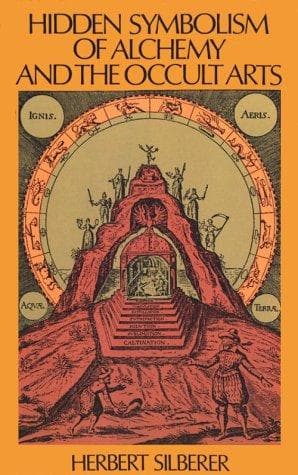
Hidden Symbolism of Alchemy and the Occult ArtsSilberer, Herbert
Religion
Hidden Symbolism of Alchemy and the Occult Arts
Silberer, Herbert
Alchemy; Society of Rosicrucians; Symbolism (Psychology)
At any rate in primitive symbolism there seems to be a religious idea at
the bottom of the recommendation to use the sputum lunæ (moon spittle) or
sperm astrale (star semen), star mucus, in short of an efflux from the
world of light above us, as first material for the work of our
illumination. [In many alchemistic recipes such things are recommended.
Misunderstanding led to a so-called shooting star substance being eagerly
hunted for. What was found and thought to be star mucus was a gelatinous
plant.] So it is in this passage from John IX, 5, ff.: “As long as I am in
the world I am the light of the world. When he [Jesus] had thus spoken, he
spat on the ground and made clay of the spittle and anointed the eyes of
the blind man with the clay, and said unto him, Go, wash in the pool of
Siloam [which is by interpretation: Sent]. He went his way, therefore,
washed, and came seeing.” The transference of a virtue by the receiving of
a secretion is a quite common primitive idea.
As Michael Maier (Symbola Aureae Mensae Lib. XI) informs us, Melchior
Cibinensis, a Hungarian priest, expressed the secrets of the forbidden art
in the holy form of the Mass. For as birth, life, exaltation, suffering in
fire and then death were, as it were, ascribed to the Philosopher’s Stone
in black and gloomy colors, and finally resurrection and life in red and
other beautiful colors, so he compared his preparation with the work of
the salvation of man (and the “terrestrial” stone with the “celestial”
stone), namely, with the birth, life, suffering, death and resurrection of
Christ. (Höhler, Herm. Phil., p. 156.) The making of the Philosopher’s
Stone is, so to speak, the Imitation of Christ.
Hitchcock (H. A., p. 143) believes that Irenaeus Philaletha has clearly
alluded in a passage of his writings to the two mental processes, analysis
and synthesis, which lead to the same end. “To seek the unity through Sol,
I take it, is to employ the intellect upon the Idea of Unity, by analysis
that terminates in the parts; whereas to study upon Mercury, here used for
nature at large, is to work synthetically, and by combining the parts,
reach an idea of the unity. The two lead to the same thing, beginning as
it were from opposite extremes; for the analysis of any one thing,
completely made, must terminate in the parts, while the parts, upon a
synthetical construction, must reproduce the unity. One of the two ways
indicated by Irenaeus is spoken of as a herculean labor, which I suppose
to be the second, the reconstruction of a unity by a recombination of the
parts, which in respect to nature is undoubtedly a herculean undertaking.
The more hopeful method is by meditation, etc.”
Public-domain text, read in full here on John Shaqi.
Reviews
Reviews
No reviews yet
Be the first to share your thoughts on this work.
Elsewhere in the archive
Join the Discussion
Join the discussion
Sign in to leave a comment or review.
Sign InorCreate an account