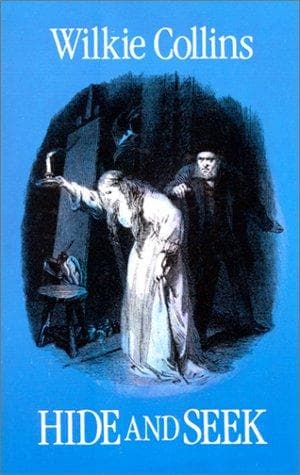
Deaf women -- Fiction; Father figures -- Fiction; Painters -- Fiction; Psychological fiction; Young men -- Fiction
From this doorway there now appeared Mr. Jubber himself, clothed in
white trousers with a gold stripe, and a green jacket with military
epaulettes. He had big, bold eyes, a dyed mustache, great fat, flabby
cheeks, long hair parted in the middle, a turn-down collar with a
rose-colored handkerchief; and was, in every respect, the most atrocious
looking stage vagabond that ever painted a blackguard face. He led with
him, holding her hand, the little deaf and dumb girl, whose misfortune
he had advertised to the whole population of Rubbleford.
The face and manner of the child, as she walked into the center of the
circus, and made her innocent curtsey and kissed her hand, went to the
hearts of the whole audience in an instant. They greeted her with such
a burst of applause as might have frightened a grown actress. But not a
note from those cheering voices, not a breath of sound from those loudly
clapping hands could reach her; she could see that they were welcoming
her kindly, and that was all!
When the applause had subsided, Mr. Jubber asked for the loan of a
handkerchief from one of the ladies present, and ostentatiously bandaged
the child’s eyes. He then lifted her upon the broad low wall which
encircled the ring, and walked her round a little way (beginning from
the door through which he had entered), inviting the spectators to test
her total deafness by clapping their hands, shouting, or making any
loud noise they pleased close at her ear. “You might fire off a cannon,
ladies and gentlemen,” said Mr. Jubber, “and it wouldn’t make her start
till after she’d smelt the smoke!”
To the credit of the Rubbleford audience, the majority of them declined
making any practical experiments to test the poor child’s utter
deafness. The women set the example of forbearance, by entreating that
the handkerchief might be taken off so that they might see her pretty
eyes again. This was done at once, and she began to perform her
conjuring tricks with Mr. Jubber and one of the ring-keepers on either
side of her, officiating as assistants. These tricks, in themselves,
were of the simplest and commonest kind; and derived all their
attraction from the child’s innocently earnest manner of exhibiting
them, and from the novelty to the audience of communicating with her
only by writing on a slate. They never tired of scrawling questions, of
saying “poor little thing!” and of kissing her whenever they could get
the opportunity, while she slowly went round the circus. “Deaf and dumb!
ah, dear, dear, deaf and dumb!” was the general murmur of sympathy which
greeted her from each new group, as she advanced; Mr. Jubber invariably
adding with a smile: “And as you see, ladies and gentlemen, in excellent
health and spirits, notwithstanding: as hearty and happy, I pledge you
my sacred word of honor, as the very best of us!”
Public-domain text, read in full here on John Shaqi.
Reviews
Reviews
No reviews yet
Be the first to share your thoughts on this work.
Join the Discussion
Join the discussion
Sign in to leave a comment or review.
Sign InorCreate an account