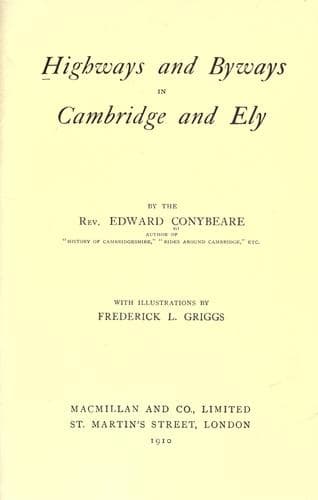
Highways and Byways in Cambridge and ElyConybeare, John William Edward
History
Highways and Byways in Cambridge and Ely
Conybeare, John William Edward
Cambridgeshire (England) -- Description and travel; Isle of Ely (England) -- Description and travel
The undergraduates of Caius wear a gown of a singular and not very
pleasing violet hue with velvet trimmings. The College "colours" are
light blue and black; the former, which is, as all know, the
University colour, having been granted them to use, in memory of a
famous race, in the early days of College boating, seventy years ago,
when their crew beat the University Eight. It is, of course, an
axiomatic rule of sportsmanship that no Club may assume the insignia
of another (or any colourable imitation thereof), without leave from
the previous users. The earliest "Light Blues" were the Eton Boat
Club, by whose permission the Cambridge Boat Club took the colour. The
Cricket Clubs, at both Eton and Cambridge, were then permitted to use
it, and now this permission has been extended to all engaged as
champions of the University, at athletics, football, etc.
The Senate House, to the entrance of which the Gate of Honour has
brought us, is the nerve-centre of the University. Here are held,
usually on each Thursday during Term, the meetings ("Congregations" is
the official word) of that august body the "Senate," to whose vote all
University legislation must ultimately be submitted. This body,
however, consisting as it does of all who have attained the Degree of
Master of Arts, several thousands in number, is far too large to
initiate that legislation. This is done by a small elected General
Committee, the "Council," and by special Committees (or "Syndicates")
dealing with the various special subjects to be considered. Both
Council and Syndicates also act as executive authorities, and by them
"Graces" embodying this or that proposal are from time to time laid
before the Senate. The Grace is read aloud by one of the Proctors, in
his robes of office, standing beside the Chair, which is occupied by
the Vice-Chancellor.[77] The benches are tenanted by such members of
the Senate as care to be present.[78] There is no discussion;[79] but,
on the Grace being read, any member may utter the words "Non Placet,"
whereupon the Proctor cries "Ad scrutinium," and the congregation
divides; the "Placets," (or "Ayes" as they would be called in
Parliament), moving to the right of the Chair, and the "Non-Placets"
to the left. Should this grouping not sufficiently disclose the sense
of the meeting, a poll is held; each member's vote being given
publicly by writing, on an official form, avouched by his signature.
These papers are then counted by the Proctors, and their respective
numbers read out by the Vice-Chancellor.
[Footnote 77: This officer is the acting Head of the University, and
is appointed by the Council from amongst the Heads of the Colleges,
usually by rota, year by year. The Chancellor, whom he represents, is
always some specially distinguished notability, and is appointed for
life. He is only present on state occasions.]
Public-domain text, read in full here on John Shaqi.
Reviews
Reviews
No reviews yet
Be the first to share your thoughts on this work.
Elsewhere in the archive
Join the Discussion
Join the discussion
Sign in to leave a comment or review.
Sign InorCreate an account