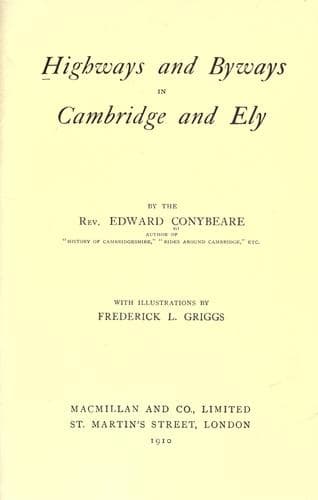
Highways and Byways in Cambridge and ElyConybeare, John William Edward
History
Highways and Byways in Cambridge and Ely
Conybeare, John William Edward
Cambridgeshire (England) -- Description and travel; Isle of Ely (England) -- Description and travel
[Footnote 78: Members are often able to introduce ladies, when there
is likely to be room for them. And undergraduates may listen to
proceedings from the Galleries, where, in defiance of rule, they are
often heard as well as seen, should the business be exciting.]
[Footnote 79: Such discussion as may seem needful has already taken
place before a Meeting of the resident Members of the Senate, who have
spent at least forty nights in Cambridge during the last Academic
year, and whose names are accordingly on the "Electoral Roll." They
are summoned, as required, by the Vice-Chancellor, to discuss the
various matters which it is proposed to embody in "Graces."]
These numbers are usually but small; indeed most of the business is
altogether unopposed. But when some subject which excites general
interest is brought forward, "backwoods-men" flock (and are whipped)
up from all parts of England. Macaulay has given us a humorous poem on
the coach-loads of country clergy thus pitch-forked into Cambridge to
vote against the admission of Roman Catholics to the University; and
within the last few decades, similar scenes were witnessed in
connection with the question of their being allowed a recognised
Public Hostel of their own, and with those of Compulsory Greek, and of
granting Degrees to women.
Such is the procedure at the Senate House; or, rather, such it has
hitherto been, for the whole question of University legislation is
even now in the melting-pot. The use of the building for the chief
University examinations is also dying or dead, now that a vast
"Examination Hall" has been built for that purpose. But Degrees still
continue to be conferred there; the students found worthy by the
examiners successively kneeling before the Vice-Chancellor, and being
admitted by him to their degree in the name of the Trinity. They are
presented by the "Fathers" of their respective Colleges, in a
recognised order, beginning with the Royal Foundations, King's always
coming first and Trinity second. When the Degree of Doctor ("Honoris
causa") is conferred on any distinguished visitors, the place is
thronged, and each in turn is introduced with a laudatory Latin speech
by the "Public Orator," who has to exert his ingenuity in composing
some neat and appropriate epigrammatic remark about him.[80]
[Footnote 80: The office thus requires no mean scholarly and
oratorical powers. When Queen Elizabeth visited Cambridge, the Public
Orator had to make her a laudatory address of half an hour in
duration, without notes, "with the Queen's horse curvetting under her"
(for this was not in the Senate House--yet unbuilt--but in the open
air before King's College Chapel), and with constant mock-modest
interruptions from her Royal lips. Her only thanks were a commendation
of his excellent memory.]
Public-domain text, read in full here on John Shaqi.
Reviews
Reviews
No reviews yet
Be the first to share your thoughts on this work.
Elsewhere in the archive
Join the Discussion
Join the discussion
Sign in to leave a comment or review.
Sign InorCreate an account