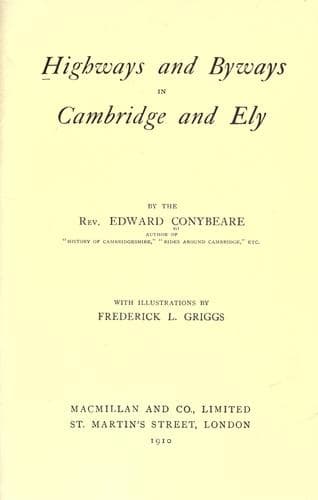
Highways and Byways in Cambridge and ElyConybeare, John William Edward
History
Highways and Byways in Cambridge and Ely
Conybeare, John William Edward
Cambridgeshire (England) -- Description and travel; Isle of Ely (England) -- Description and travel
The Senate House is a stately classical building, running east and
west, erected in the early decades of the eighteenth century. Up to
that date the functions which it now discharges were served partly by
the old Schools (now the University Library), which have been already
spoken of, and which adjoin it on the west, and partly by the
University Church (called here, as at Oxford, "Great St. Mary's"),
which stands hard by to the east. The legislative meetings of the
Senate were held in the former,[81] the Degrees were conferred, and
other gatherings held, in the latter.
[Footnote 81: One apartment was called the Regent House, as being thus
used by the Governing Body of the University.]
This was all very well before the Reformation, whilst reverence for
consecrated places still held its own; but, after that great
convulsion, the proceedings too frequently were markedly
unecclesiastical in tone. The conferring of Degrees was originally a
solemn function beginning with High Mass, and continuing with a
serious _viva voce_ exercise of the candidates in the presence of the
Vice-Chancellor. But when the Reformation had made it fashionable to
show a healthy Protestant contempt for the old Catholic superstitions,
the whole ceremony was deliberately turned into a farce. The
questioning of the candidates was no longer done by grave University
officials, but by an "old" (_i.e._ a senior) Bachelor, who sat upon a
three-legged stool, and made his interrogations as profane and
scurrilous as possible. He was known, from his stool, as "Mr. Tripos,"
and so essential a part of the proceedings did he become that "Tripos"
got to be (as it still is) the regular name for an "Honour"
examination at Cambridge. To judge by the few that have come down to
us, the jokes current on these occasions were poor to the last degree.
Thus, in 1657, we read that two Oxonians, got up as hobby-horses,
presented themselves, giving as their qualification that they "had
smith's work at their digits' ends," (Smith being a then current
writer of school books). They were duly admitted, on the ground that
"such _equitation_ gave them an _equitable_ claim!" And all this was
in the church; where, indeed, far less innocent performances were
constantly given, including stage-plays and recitations in which the
most solemn mysteries of the Catholic Faith were often travestied and
held up to ridicule.[82]
[Footnote 82: As Protestantism lost its first militant fervour, these
performances more and more dropped their polemical features. But they
still remained most inappropriate for a place of worship. We have seen
how the higher minds of the University, such as Dr. Barrow, felt about
them before the seventeenth century came to an end. (See p. 104.)]
Public-domain text, read in full here on John Shaqi.
Reviews
Reviews
No reviews yet
Be the first to share your thoughts on this work.
Elsewhere in the archive
Join the Discussion
Join the discussion
Sign in to leave a comment or review.
Sign InorCreate an account