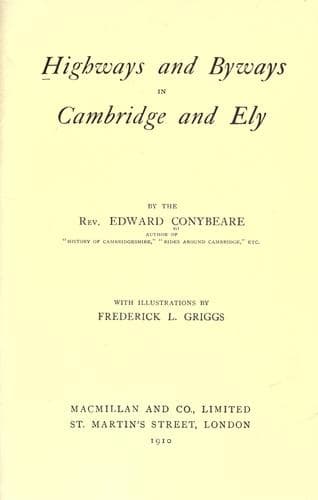
Highways and Byways in Cambridge and ElyConybeare, John William Edward
History
Highways and Byways in Cambridge and Ely
Conybeare, John William Edward
Cambridgeshire (England) -- Description and travel; Isle of Ely (England) -- Description and travel
The western portion of that common is often called "Jesus Green." It
witnessed the execution of the only Marian martyr burnt at Cambridge.
His pile was largely formed of Protestant books of devotion, one of
which, "a Communion Book," he picked up and read diligently till the
flames overpowered him, "praising God, who had sent him this
consolation in his death."
CHAPTER VII
=Sidney Sussex College=, Oliver Cromwell, Fellow Commoners.--Holy
Trinity, Simeon, Henry Martyn.--=Christ's College=, "God's
House," Lady Margaret, Flogging of Students, Bathing forbidden,
Milton, Lycidas, Gardens, Paley, Darwin.--Great St. Andrew's,
Bishop Perry.--=Emmanuel College=, Harvard, Sancroft, Chapel,
Ponds.--University Museums.--=Downing College.=--Coe Fen.--First
Mile Stone.--Barnwell, Priory, Abbey Church.--Lepers Chapel,
Stourbridge Fair, Vanity Fair.
Following Jesus Lane from the "Chimney" gate townwards, we once more
strike into the Via Devana, here called Sidney Street, from the
College filling the angle between the two roads. It is not a
pretentious institution, having always been amongst the smallest
colleges. But it has nurtured one man of colossal individuality, the
great Protector, Oliver Cromwell. For Sidney Sussex College (as its
full name runs, from its foundress, Lady Frances Sidney,[104] Countess
of Sussex) was instituted (in 1596) for the very purpose of fostering
such _alumni_. The earliest statutes of the College decree that its
members shall be taught, before all else, to "detest and abhor
Popery." Besides Cromwell, his right-hand man, Edward Montagu, Earl of
Manchester, who distinguished himself when in authority at Cambridge
during the Civil War by ejecting from their parishes so many recusant
High Church parsons and filling their places with Puritan divines, was
also a Sidney man. Both he and Cromwell were "Fellow Commoners," a
name given to privileged undergraduates who, on payment of extra fees,
were permitted to rank with the Fellows and to dine at the High Table.
They also wore a more ornate gown than the ordinary undergraduate. It
is only of late years that this plutocratic arrangement has been
discontinued in the University. The site of Sidney was formerly that
of the Franciscan Convent, with its splendid church, considered the
finest in Cambridge. At the dissolution of the convent the University
tried to secure this from King Henry the Eighth as the University
Church. But the King's price was too high, the negotiations fell
through, and the glorious building was remorselessly and utterly
demolished.
[Footnote 104: Her husband had been over the Royal Excise, and the
College shield bears the familiar Broad Arrow of that department.]
Public-domain text, read in full here on John Shaqi.
Reviews
Reviews
No reviews yet
Be the first to share your thoughts on this work.
Elsewhere in the archive
Join the Discussion
Join the discussion
Sign in to leave a comment or review.
Sign InorCreate an account