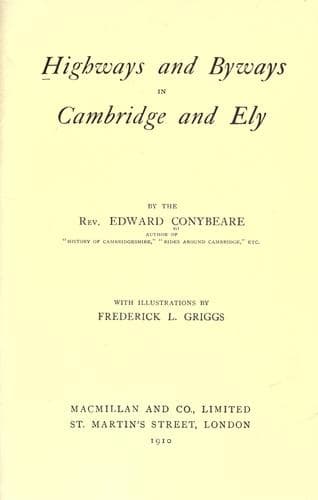
Highways and Byways in Cambridge and ElyConybeare, John William Edward
History
Highways and Byways in Cambridge and Ely
Conybeare, John William Edward
Cambridgeshire (England) -- Description and travel; Isle of Ely (England) -- Description and travel
North-east of Cambridge stretch the mesh of dingy streets which make
up the great suburb of Barnwell. Hither and thither they run, in
soul-crushing monotony; yet even here there are gems of interest to be
found. The suburb came into existence, to begin with, through the
proximity of a great Abbey, the Augustinian Priory of Barnwell. This
House of Religion was founded in the first instance by Hugoline, the
pious wife of Picot, William the Conqueror's far from pious Sheriff of
Cambridgeshire. It was by her located close beneath his
dwelling-place in the Castle, and dedicated to St. Giles. Half a
century later, the Picot land was forfeited for treason, and granted
to Richard Peverel, who had been, in the First Crusade,
standard-bearer to Robert Curthose, the Conqueror's eldest son. He
transferred the House to the riverside, hard by a holy spring, the
Burn Well (or source of the Brook), where a hermit of special sanctity
had already reared an Oratory dedicated to St. Andrew. He also raised
the number of monks from six to thirty, to correspond with that of his
own years at the time.
The Abbey grew and flourished. Its inmates, as appears from their
"Custom Book" of 1296 (lately published by Mr. J. W. Clark), led a
very civilised life--cleanliness being specially insisted upon; and
its proximity to Cambridge placed it in touch with political life.
Royalty stayed in it now and again; in 1388 even Sessions of
Parliament were held in it; Papal Legates visited it.[120] And when
civil wars broke out, it was a prize worth plundering; a fate it more
than once suffered. When the final plunder came, under Henry the
Eighth, the whole was utterly swept away; the only thing left being a
small stone building, which was apparently the Muniment room of the
Abbey. Though utterly ruinous, this little block is by no means
without architectural merit, and may be found by following the
Newmarket Road (which enters Cambridge as "Jesus Lane") to its
junction with East Road (the eastward continuation of Lensfield Road).
Here Abbey Street runs down to the river, and just off it is our
building, commonly known as the "Priory Chapel." Hard by is an old
red-brick dwelling-house, bearing the date 1578, and called the "Abbey
Barn"; and in its grounds are several venerable fragments.
[Footnote 120: Here was held, in 1430, under the representatives of
Pope Martin the Fifth, the famous "Assize of Barnwell," which decided,
by Papal authority, that in the University alone was vested all
spiritual jurisdiction over its students, to the exclusion of the
ordinary Diocesan and Parochial claims.]
Public-domain text, read in full here on John Shaqi.
Reviews
Reviews
No reviews yet
Be the first to share your thoughts on this work.
Elsewhere in the archive
Join the Discussion
Join the discussion
Sign in to leave a comment or review.
Sign InorCreate an account