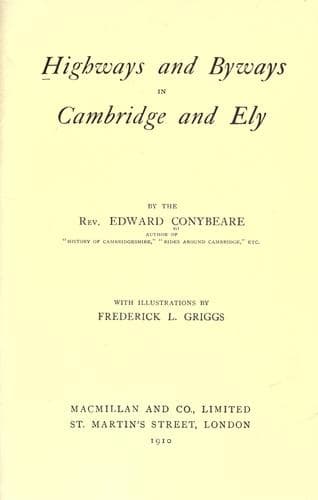
Highways and Byways in Cambridge and ElyConybeare, John William Edward
History
Highways and Byways in Cambridge and Ely
Conybeare, John William Edward
Cambridgeshire (England) -- Description and travel; Isle of Ely (England) -- Description and travel
Pursuing the Newmarket Road, we find (at the point where it at last
ceases to be a Barnwell Street, and crosses the railway into the open
country beyond), yet another tiny ancient church, called traditionally
the "Lepers' Chapel." It is of Norman date, and probably served the
Lepers' Hospital, which we know to have existed hereabouts, as remote
as might be from the town. This hospital was endowed by King John
with the tolls of the great Fair held hard by on Stourbridge Common,
which even so late as the Eighteenth Century boasted itself the
largest and most important in all Europe, a position now claimed by
that of Nijni Novgorod in Russia. And, to judge by the accounts that
have come down to us, the boast was not unfounded. The Cambridgeshire
historian, Carter, writing in 1753, thus describes it:
"Stourbridge Fair ... is set out annually on St. Bartholomew by
the Mayor, Aldermen, and the rest of the Corporation of
Cambridge; who all ride thither in a grand procession, with music
playing before them, and most of the boys in the town on
horseback after them, who, as soon as the ceremony is read over,
ride races about the place; when returning to Cambridge each boy
has a cake and some ale at the Town Hall. On the 7th of September
they ride in the same manner to proclaim it; which being done,
the Fair begins, and continues three weeks; though the greatest
part is over in a fortnight.
"This Fair, which was thought some years ago to be the greatest
in Europe, is kept in a cornfield, about half a mile square,
having the River Cam running on the north side thereof, and the
rivulet called the Stour (from which and the bridge over it the
Fair received its name) on the east side, and it is about two
miles east of Cambridge market-place; where, during the Fair,
coaches, chaises, and chariots attend to carry persons to the
Fair. The chief diversions at Stourbridge are drolls,
rope-dancing, and sometimes a music-booth; but there is an Act of
Parliament which prohibits the acting of plays within fifteen
miles of Cambridge.
"If the field (on which the Fair is kept) is not cleared of the
corn by the 24th of August, the builders may trample it under
foot to build their booths; and, on the other hand, if the same
be not cleared of the booths and material belonging thereto by
Michaelmas Day at noon, the plough-men may enter the same with
their horses, ploughs, and carts, and destroy whatever they find
on the premises. The filth, dung, straw, etc., left behind by the
fair-keepers, make amends for their trampling and hardening of
the ground.
Public-domain text, read in full here on John Shaqi.
Reviews
Reviews
No reviews yet
Be the first to share your thoughts on this work.
Elsewhere in the archive
Join the Discussion
Join the discussion
Sign in to leave a comment or review.
Sign InorCreate an account