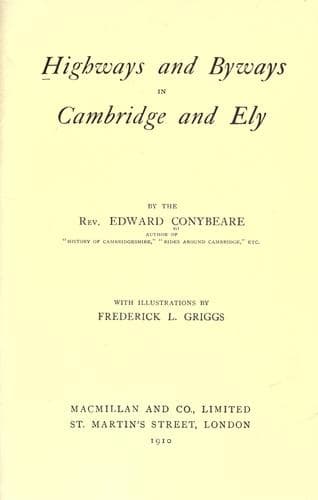
Highways and Byways in Cambridge and ElyConybeare, John William Edward
History
Highways and Byways in Cambridge and Ely
Conybeare, John William Edward
Cambridgeshire (England) -- Description and travel; Isle of Ely (England) -- Description and travel
The Isle, which contains the whole of the fenland forming this
northern half of Cambridgeshire, is far older as a political entity
than the southern part of the county. Its existence dates back to the
far-off days of the Anglo-Saxon conquest, in the fifth and sixth
centuries, when the poor remnants of the British population in East
Anglia, once the proud tribe of "the great Iceni," fled for refuge
into the "dismal swamp" of the Fens. Here they held out for centuries,
and formed themselves into a new tribe, the Girvii (as our earliest
Latin chronicler transliterates the Welsh name Gyrwy, signifying
"brave men," by which they called themselves). This Girvian
principality has ever since held together. It passed as a whole into
the hands of St. Etheldreda, by her marriage (in 652 A.D.) with the
last Girvian Prince, Tonbert, and from her to her successors the
Abbots and Bishops of Ely, whose jurisdiction survived until the
nineteenth century.
Meanwhile the old southland homes of the unhappy Britons were being
shared up by their English exterminators. The East Anglians swarmed
over the uplands to the east, and joined hands (not in friendship)
with the more powerful Mercians swarming in from the west. Roughly
speaking the Cam divided these jarring tribes, which lived in undying
hostility till the various English Kingdoms were united into one (in
A.D. 827) by the genius and valour of Egbert, the first "King of the
English." But the boundaries were not effaced till the desolating
flood of the Danish invasions poured over all.
When that flood was stayed by Egbert's glorious grandson, Alfred the
Great, and the district once more made English and Christian by his
only less glorious son, Edward "the Elder," it was formed by him into
a County called, from its chief town, Cambridgeshire (or, as it was
then, "Granta-bryg-shire"). This was in the year 921. But for the
first idea of any union between this new County and the old Isle of
Ely we must wait another two centuries, when, in 1107, the Abbot of
Ely became a Bishop, with the Isle and the County together for his
See. The ecclesiastical tie thus formed has gradually developed into a
civil tie also; just as the first union of the English race under a
common Primate, the Archbishop of Canterbury, paved the way for its
union under a common King.
Public-domain text, read in full here on John Shaqi.
Reviews
Reviews
No reviews yet
Be the first to share your thoughts on this work.
Elsewhere in the archive
Join the Discussion
Join the discussion
Sign in to leave a comment or review.
Sign InorCreate an account