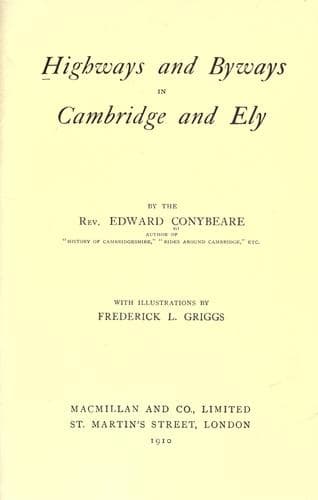
Highways and Byways in Cambridge and ElyConybeare, John William Edward
History
Highways and Byways in Cambridge and Ely
Conybeare, John William Edward
Cambridgeshire (England) -- Description and travel; Isle of Ely (England) -- Description and travel
At the Roman conquest of Britain in 55 A.D. the Iceni were friendly to
the invaders, whom indeed they had invited into the land, to free them
from their subjection to the House of Cymbeline, King of Britain. But
when, a few years later, during the settlement of the country, the
Roman general Ostorius ordered them to give up their arms, they
regarded the demand as an intolerable insult, and bade him defiance,
manning the Fleam Dyke against him. But such was his energy that,
though he had no regular troops with him, his light-armed auxiliaries
stormed the whole length of the line at a single rush. The routed
Icenians fled in panic homewards, only to find their way hopelessly
barred by their own fortifications along the Devil's Dyke, and all but
the few who could force their way through the mad crush at this one
narrow gap, were, in spite of a desperate resistance, slaughtered
wholesale. The tribe were then disarmed, and endured unresistingly the
licence and greed of Roman officials and Roman moneylenders, till
goaded into madness, twelve years later, by the wrongs of their
"warrior-queen," Boadicea. Then followed that convulsive explosion of
popular rage and despair, in which every Roman within reach was
massacred with every circumstance of horror, and to which the Romans,
after their victory, replied by such a policy of extermination as to
blot the Icenian name from the page of history. Never again do we meet
with it.
Between the Dyke and Newmarket lies the Heath, renowned as the
earliest English race-course. This form of amusement seems to have
come in with the Stuart Dynasty. James the First is said to have
inaugurated the sport. But the well-known tale of how Edward the First
escaped from his captivity at Hereford, by inducing his guards to ride
matches till their horses were exhausted and then galloping off on
his own fresh mount, shows that the idea was afloat long before. And
at Newmarket in particular such matches must often have been ridden in
connection with the great horse mart which has given the town its
name.
This New Market is, like the New Forest, now far from new. It dates
from the year 1227, when a frightful outbreak of sickness frightened
away buyers and sellers from their older market-place two miles off at
Exning (a pretty natural amphitheatre of turf bright with many
springs), and sent them to meet for the future in the freer air of the
Heath. This word, by the way, does not, in Cambridgeshire, imply the
existence of heather, merely meaning an open space.
Public-domain text, read in full here on John Shaqi.
Reviews
Reviews
No reviews yet
Be the first to share your thoughts on this work.
Elsewhere in the archive
Join the Discussion
Join the discussion
Sign in to leave a comment or review.
Sign InorCreate an account