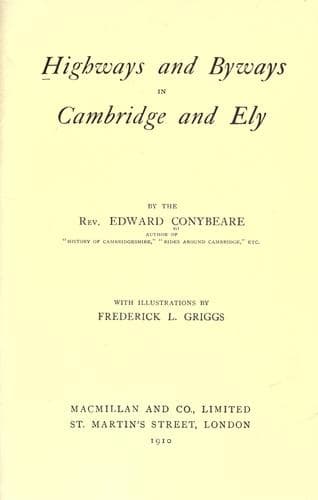
Highways and Byways in Cambridge and ElyConybeare, John William Edward
History
Highways and Byways in Cambridge and Ely
Conybeare, John William Edward
Cambridgeshire (England) -- Description and travel; Isle of Ely (England) -- Description and travel
Thus Newmarket came into being. The sport we first hear of in
connection with it is not racing but hunting. For the boundless range
of the moorlands to the east of the town (which even now astonish all
who first see them) were then haunted by innumerable herds of wild
deer, and afforded ideal ground for the chase. James the First,
accordingly, had here a hunting-box,[127] in which his unhappy son was
afterwards imprisoned for a while by the victorious army of the
Commonwealth. And thus the Heath became known to his "merry" grandson,
Charles the Second, who speedily saw how specially adapted its expanse
was for horse-racing, and established a regular annual race-meeting,
the first to be introduced into England.
[Footnote 127: In the Register of Fordham Church (a few miles north of
Newmarket) is an entry to the effect that, on 27 February 1624, "The
Most High and Mighty Prince, King James the First of England and Sixth
of Scotland condescended to hunt six hares in Fordham Field!"]
The Royal sport spread like wildfire, and the bare Heath became year
by year crowded by the gayest throng in England, thus vividly
described by Macaulay:
"It was not uncommon for the whole Court and Cabinet to go down
there," Charles himself, to the admiration of his subjects,
posting down from London in a single day, with only two relays of
fresh horses. "Jewellers and milliners, players and fiddlers,
venal wits and venal beauties, followed in crowds. The streets
were made impassable by coaches and six. In the places of public
resort peers flirted with maids of honour, and officers of the
Life Guards, all plumes and gold lace, jostled professors in
trencher caps and black gowns. For on such occasions the
neighbouring University of Cambridge always sent her highest
functionaries with loyal addresses, and selected her ablest
theologians to preach before the Sovereign and his splendid
retinue. In the wild days before the Revolution, indeed, the most
learned and eloquent divine might fail to draw a fashionable
audience, particularly if Buckingham announced his intention of
holding forth; for sometimes his Grace would enliven the dulness
of a Sunday morning by addressing to the bevy of fine gentlemen
and fine ladies a ribald exhortation which he called a sermon.
With lords and ladies from St. James's and Soho, and with doctors
from Trinity College and King's College, were mingled the
provincial aristocracy, fox-hunting squires and their
rosy-cheeked daughters, who had come in queer-looking family
coaches, drawn by cart-horses, from the remotest parishes of
three or four counties to see their Sovereign.... Racing was only
one of the many amusements of that festive season. On fine
mornings there was hunting. For those who preferred hawking,
choice falcons were brought from Holland. On rainy days the
Public-domain text, read in full here on John Shaqi.
Reviews
Reviews
No reviews yet
Be the first to share your thoughts on this work.
Elsewhere in the archive
Join the Discussion
Join the discussion
Sign in to leave a comment or review.
Sign InorCreate an account