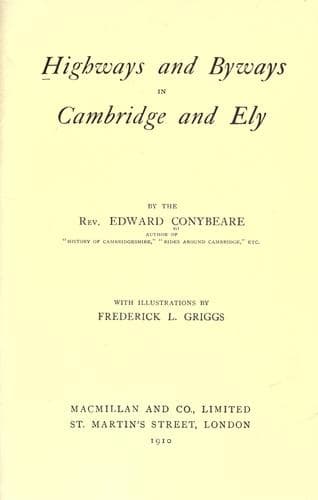
Highways and Byways in Cambridge and ElyConybeare, John William Edward
History
Highways and Byways in Cambridge and Ely
Conybeare, John William Edward
Cambridgeshire (England) -- Description and travel; Isle of Ely (England) -- Description and travel
Suffolk, it must be remembered, is not, like Cambridgeshire,
Bedfordshire, and other counties named after their chief town, an
artificial division of the land, called into being by the Government
merely as an administrative unit, but, like the Isle of Ely, one of
the originally independent principalities the gradual accretion of
which has formed England. Very early Suffolk and Norfolk joined
together in one East Anglian Kingdom; but that Kingdom endured for
centuries, and was not extinguished till its last monarch, St. Edmund,
was murdered by the Danes in their great raid of 870 A.D. He was,
indeed, but a tributary monarch, under the King of the English; but
this was then only a quite recent arrangement, and his predecessors
had been wholly independent sovereigns. For many years they were
engaged in a heroic struggle to preserve their independence against
Mercia, the great power which occupied all the Midlands, and therefore
it was that they fixed their Royal abode at Exning, close to the great
dyke which bulwarked the East Anglian realm, as, long before, it had
bulwarked the Icenian.
Hence it came about that Exning was the birthplace of St. Etheldreda,
the foundress of our great "sacred fane" at Ely, round which, almost
more than Cambridge itself, the fortunes of Cambridgeshire have
centred. Her father, King Anna, was called to the East Anglian throne
in troublous times. Christianity and Paganism were at death-grips
throughout the land. And the latter cause was championed by the
monarch who was, for the moment, far the most powerful of the English
sovereigns, Penda, King of Mercia. From his central position he struck
out north, south, and east, at his Christian neighbours. His first
blows were against Northumbria, where he successively shattered the
Roman Mission of Paulinus and the Celtic Mission of Aidan. Next he
drove into exile Kenwalk, the first Christian King of Wessex, and
finally, in 654, burst over the East Anglian frontier "like a wolf, so
that Anna and his folk were devoured as in a moment."
Public-domain text, read in full here on John Shaqi.
Reviews
Reviews
No reviews yet
Be the first to share your thoughts on this work.
Elsewhere in the archive
Join the Discussion
Join the discussion
Sign in to leave a comment or review.
Sign InorCreate an account