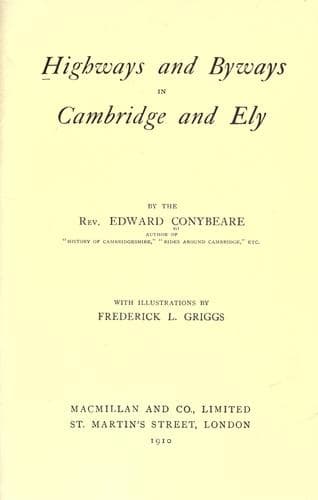
Highways and Byways in Cambridge and ElyConybeare, John William Edward
History
Highways and Byways in Cambridge and Ely
Conybeare, John William Edward
Cambridgeshire (England) -- Description and travel; Isle of Ely (England) -- Description and travel
But this breaking up of the Exning family did but scatter its members
to spread far and wide the cause of the Gospel. And a splendid band
they were. Not for nothing is Anna described by Bede as "a good man,
and the father of an excellent family." His eldest son followed him on
the throne (for Penda was slain shortly after his last victory, and
the Mercian dominion fell with him), and helped St. Etheldreda in her
great work at Ely; another son, St. Erconwald, became one of the most
famous of all the Bishops of London; while, of the daughters, one was
Abbess of Barking, another of Dereham, another of Brie, in
France.[128] Yet another, Sexburga, after being Queen of Kent,
succeeded Etheldreda as Abbess of Ely, and was herself succeeded by
her daughter Ermenilda, who, as Queen of Penda's son Wulfhere, had
taken part in St. Chad's great work of converting Mercia. Seldom has
any place bred such a household of Saints as this quiet little village
of Exning. A pretty village it still is; but is now fast becoming a
suburb of Newmarket. The bright little stream running through it is
derived partly from springs in the old market meadow already spoken of
(known as "the Seven Springs"), and partly from sources in a copse
some half-mile to the south, known as St. Wendred's Well. All we know
of this obscure Saint is that she had a local fame in the tenth
century, when her body, in a golden coffin, was brought from Ely to
the great battle between Edmund Ironside and Canute at Assandun, and
became the spoil of the victor. The church at March is dedicated to
her.
[Footnote 128: Her abbey was for generations the favourite
boarding-school in France for young ladies from England.]
The road from Newmarket to Ely (twelve miles) passes several places
worth notice. First comes Snailwell, with the flint-built round tower
of its little church rising so picturesquely above the "well," now a
broad, clear pond, from which the little river Snail crawls away into
the adjacent fen. At the adjoining hamlet of Landwade there was lately
unearthed a Roman villa, the fine tesselated pavement of which is now
in the Sedgwick Museum of Cambridge.
Fordham, which we next reach, is a larger village, with a church of
most unusual architectural interest. The north porch has a stone roof
of no fewer than six vaulted bays, running east and west, and
supporting a parvis chamber, with late Decorated windows, approached
by a stone staircase from without, and, seemingly, designed for a
chapel with a separate dedication to St. Mary Magdalene, the Church
being St. Peter's. This development is unique.
[Illustration: _Fordham Church._]
Public-domain text, read in full here on John Shaqi.
Reviews
Reviews
No reviews yet
Be the first to share your thoughts on this work.
Elsewhere in the archive
Join the Discussion
Join the discussion
Sign in to leave a comment or review.
Sign InorCreate an account