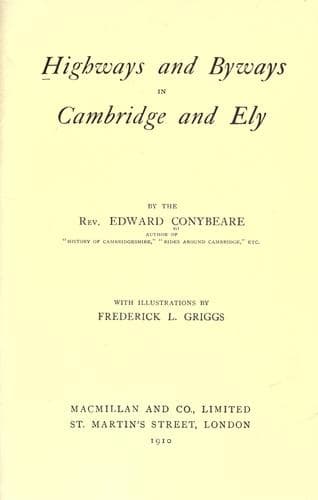
Highways and Byways in Cambridge and ElyConybeare, John William Edward
History
Highways and Byways in Cambridge and Ely
Conybeare, John William Edward
Cambridgeshire (England) -- Description and travel; Isle of Ely (England) -- Description and travel
These birds belong to Chippenham Hall, a mansion built by Admiral
Russell, the hero of La Hogue in 1692, our first great naval victory
since the rout of the Armada, "and the first great victory that the
English had gained over the French since the day of Agincourt."[134]
It stands on the site of an earlier house, which, in its day, served
as a place of confinement for Charles the First in 1647, after the
raid by Cornet Joyce on Holmby House had transferred his custody from
the hands of the Parliament to those of the Army. Here he remained for
some weeks, while the somewhat sordid game of political intrigue (out
of which he still hoped to make his own) was being played around him,
"very pleasant and cheerful, taking his recreation daily at tennis,
and delighting much in the company of Cornet Joyce," but refusing to
listen to the famous Puritan stalwart, Hugh Peters, who was
accustomed to hold forth "with the Bible in the one hand and a great
pistol in the other," and who here "moved His Majesty to hear him
preach. Which His Majesty did the rather decline."
[Footnote 134: Macaulay.]
Within sight of Soham, across the fen to the east, and only three
miles away, stood for awhile another House of Religion, the Priory of
Isleham. But to get from one to the other it was (and is) needful to
go round by Fordham, making the distance at least double. A more out
of the way place than Isleham cannot well be found, but it is worth a
visit. All that remains of the Priory is an oblong structure of stone
buttressed with red brick, looking on the outside like a barn, and,
indeed, used as such. But it is, in fact, the hulk of the Priory
Church; and, inside, the pillars and capitals are in very fair
condition. The work is all Norman. This short-lived establishment was
built in the eleventh century, as a "cell" (or outlying colony), of
the Abbey of St. Jacutus de Insula, near Dol in Brittany. Within two
centuries the monks abandoned it in favour of their sister house at
Linton.[135]
[Footnote 135: After the suppression of the alien Priories this
property went to the Crown, and was granted by Henry the Sixth to
Pembroke College, Cambridge, in whose hands it still remains.]
They may have found Isleham too sequestered. It stands, like Soham, on
the verge of the Isle of Ely, and also on the verge of Suffolk, to
which county it seems actually to have belonged throughout great part
of the Middle Ages. But it was in the Bishopric neither of Ely nor of
Norwich, but of far away Rochester, to which it had been annexed, as
tradition went, by Alfred the Great. The Church, dedicated to St.
Andrew, has an exceptionally fine hammer-beam roof, bearing the
inscription:
CRYSTOFER PEYTON DID MAK THYS ROFE
IN THE YERE OF OURE LORD MCCCCLXXXXV
BEING THE X YERE OF KINGE HENRY THE VII.
Public-domain text, read in full here on John Shaqi.
Reviews
Reviews
No reviews yet
Be the first to share your thoughts on this work.
Elsewhere in the archive
Join the Discussion
Join the discussion
Sign in to leave a comment or review.
Sign InorCreate an account