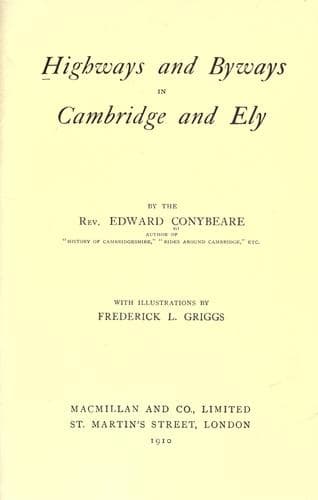
Highways and Byways in Cambridge and ElyConybeare, John William Edward
History
Highways and Byways in Cambridge and Ely
Conybeare, John William Edward
Cambridgeshire (England) -- Description and travel; Isle of Ely (England) -- Description and travel
Soham, as has been said, was on all sides surrounded by fen, except on
the narrow ridge of firm ground between it and Fordham. So
water-logged, indeed, was the country round that sea-going vessels
made a port here. This fen is now all drained and become most prosaic
cornland. But a few miles east and west of Soham two little patches,
each about a mile square, remain in their original state. These are
Chippenham Fen to the east, and Wicken Fen to the west. Both are
fairly inaccessible spots, but when we get to them they enable us to
form a vivid idea of what the state of things must have been when the
whole fenland was such as this. Both give the impression of a morass
hopelessly impenetrable, covered with a dense growth of tall reeds
rising high above your head, through which you push your way blindly,
to be constantly checked by some sluggish watercourse, too wide to
jump, too shallow to swim, and impossible to wade, for the bottom is a
fathomless stratum of soft turf and ooze giving no foothold. To
stumble into one of these watercourses is, indeed, no small peril. If
you are alone the case is well-nigh hopeless, and even a friend on the
bank would find it hard to pull you out. His best course is to cut a
fairly large bundle of reeds, by trampling which under your feet you
may for a moment be able to stand while he rescues you.
One can well understand how it came about that such a country was an
almost inviolable sanctuary for those whom despair drove to seek
refuge in its recesses. These small fragments of it still form a
sanctuary; for many rare plants and insects, exterminated elsewhere by
the march of progress, here still nourish. Conspicuous amongst these
is the lovely swallow-tail butterfly; which flits about, dashing with
bright touches of colour the weird and sombre beauty of the silent
scene. Very silent it is now. But it was not so of old, when the whole
fen was crowded with the swarming bird-life, so vividly described by
Kingsley in "Hereward the Wake": "where the coot clanked, and the
bittern boomed, and the sedge-bird, not content with its own sweet
song, mocked the notes of all the birds around, ... where hung
motionless, high over head, hawk beyond hawk, buzzard beyond buzzard,
kite beyond kite, as far as eye could see. Into the air whirred up
great skeins of wildfowl innumerable, with a cry as of all the bells
of Crowland; while clear above all their noise sounded the wild
whistle of the curlews, and the trumpet note of the great white swan."
Such was the fenland of old; but all this wealth of commotion is long
since gone, and scarcely do we see a bird now at Wicken or Chippenham,
except here and there a waterhen, and (at Chippenham) the pheasants
which are reared in coops on its margin.
Public-domain text, read in full here on John Shaqi.
Reviews
Reviews
No reviews yet
Be the first to share your thoughts on this work.
Elsewhere in the archive
Join the Discussion
Join the discussion
Sign in to leave a comment or review.
Sign InorCreate an account