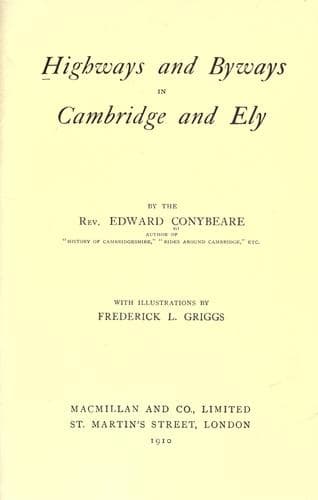
Highways and Byways in Cambridge and ElyConybeare, John William Edward
History
Highways and Byways in Cambridge and Ely
Conybeare, John William Edward
Cambridgeshire (England) -- Description and travel; Isle of Ely (England) -- Description and travel
The name of Cheveley is associated with what Professor Maitland calls
"the curious if disgraceful story of the decline and fall" of the
ancient Corporation of Cambridge.[138] When the Revolution of 1688 had
put a final end to the old Royal prerogatives over local
administration, "the Corporation stood free from national
supervision"; and Parliament, as time went on, appointed Commissioners
to undertake the duties of police and hygiene, which had formerly been
entrusted to it. With the cessation of recognised responsibilities the
Corporation also ceased to have a conscience, and shamelessly
squandered the corporate property on the personal greediness of its
members. The Duke of Rutland, from his great seat at Cheveley, became,
till the flood of nineteenth century reforms cleansed the Augean
stable, its absolute master, and his nominees only were chosen into
it, and thus, after a thousand years of strenuous, and mostly
beneficent life, "first as a knot of heathen hidesmen,[139] then as a
township of early English burg-men, then as a corporation of mediaeval
burgesses," it finally dwindled to a small dining club, "with good
wine, and plenty of it," absolutely dominated by one great Tory
magnate, and claiming "the right to expend their income on themselves
and their friends, without being bound to apply any part of it to the
good of the Town." Reform came none too soon.
[Footnote 138: _Township and Borough_, p. 96.]
[Footnote 139: The original Corporation (not yet so called) consisted
of the local residents who held (or were rated at) a "hide" of land
(120 acres). This was at the end of the ninth century, when the
landowners were Danes and heathen.]
Cheveley is some three miles from Newmarket, and, as much further on,
we reach another interesting little village, Kirtling. The local
pronunciation of the name is "Catlage," which is unhappily becoming
obsolete, like so many other local pronunciations throughout England,
under the orthographical dead level of elementary scholasticism. The
most striking edifice here is the great red-brick gate tower, with its
four octagonal turrets, which is all that remains of a mansion, in its
day one of the most famous in England. It was built in the reign of
Queen Mary by the first Lord North, whose family still hold "Kirtling
Tower," and whose son here magnificently entertained Queen
Elizabeth.[140]
[Footnote 140: A constant tradition declares that she was imprisoned
(or hidden) here during part of her sister's reign, but it cannot be
verified.]
Public-domain text, read in full here on John Shaqi.
Reviews
Reviews
No reviews yet
Be the first to share your thoughts on this work.
Elsewhere in the archive
Join the Discussion
Join the discussion
Sign in to leave a comment or review.
Sign InorCreate an account