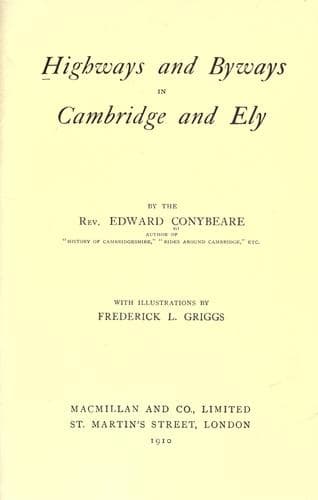
Highways and Byways in Cambridge and ElyConybeare, John William Edward
History
Highways and Byways in Cambridge and Ely
Conybeare, John William Edward
Cambridgeshire (England) -- Description and travel; Isle of Ely (England) -- Description and travel
The wide moat which surrounded it still exists, and reminds us that
this mansion was on the site of a great mediaeval castle belonging to
the Tony family, from the days of William the Conqueror to those of
Henry the Eighth. The manor had once been the property of the
ill-fated King Harold, and was given by the Conqueror to Judith, widow
of the saintly hero Waltheof, after his judicial murder. The church
contains many North monuments, and Kirtling also possesses a pretty
little Roman Catholic church, being one of the five "Missions" in
Cambridgeshire--along with Cambridge, Ely, Newmarket, and Wisbech. For
the Norths still hold, not only their ancient seat, but their ancient
Faith.
Not far from Kirtling is Wood Ditton; the last word signifying either
Ditch Town, or, more probably, Ditch End, for it stands at the upland
extremity of the Devil's Dyke. Along this ridge of the East Anglian
Heights the primaeval forest was of old so dense that no artificial
defence was needed to check the progress of an invading army. It was a
veritable wall of oak, and ash, and thorn, and holly, and alder; no
route for an army at any time, and where the felling of a few trees
across the glades would speedily form an absolutely impenetrable
obstacle. Here then the great earthwork, which we saw on Newmarket
Heath, ends its ten-mile climb from the Fen at Reach, 350 feet below.
Wood Ditton is a picturesque little place, still suggestive of
woodland, especially around the flint-built church (constructed in the
twelfth century and remodelled in the fifteenth), which has an
octagonal steeple of specially graceful poise. A large brass, in
somewhat poor condition, dating from 1393, commemorates "Henry
Englissh and Wife Margt." Henry was a Knight, and wears what is known
as "Camail" armour, which consisted of a series of small steel
roundels fastened on to leather, hardened by boiling. Dowsing records
(under date March 22, 1643), "We here brake down 50 superstitious
pictures and crucifixes. Under the Virgin Mary was written: 'O Mother
of God have mercy upon us.'"
The neighbouring village of Stetchworth (or Stretchworth) also
suffered in Dowsing's visitation. But he failed to notice that one of
the two ancient bells in the steeple had a "superstitious"
inscription:
SANCTA MARGARETA ORA PRO NOBIS.
So it remained unshattered, and still hangs in the belfry, where the
other bells also have noticeable inscriptions, two bearing the words
"God save Thy Church. 1608," and the third
OMS.SPT.LAVDA.DNM.
("Let everything that hath breath praise the Lord.")
This and the Margaret bell are ascribed to the fifteenth century.
Public-domain text, read in full here on John Shaqi.
Reviews
Reviews
No reviews yet
Be the first to share your thoughts on this work.
Elsewhere in the archive
Join the Discussion
Join the discussion
Sign in to leave a comment or review.
Sign InorCreate an account