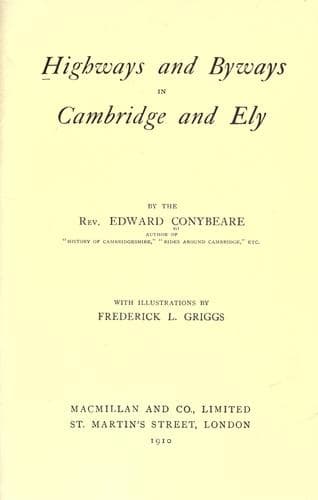
Highways and Byways in Cambridge and ElyConybeare, John William Edward
History
Highways and Byways in Cambridge and Ely
Conybeare, John William Edward
Cambridgeshire (England) -- Description and travel; Isle of Ely (England) -- Description and travel
Half-way between Cambridge and Newmarket, and half a mile from the
main road, stands the fine Church of Bottisham, with good Decorated
windows, a stone rood screen of Perpendicular work, and noteworthy
sedilia and piscina. The beautiful fluting round the clerestory
windows is still more noteworthy, and also the arcading beneath those
of the south aisle both within and without. Here is the tomb of Elyas
de Beckingham, Justice of the Common Pleas under Edward the First,
who, almost alone, escaped in the clean sweep which that monarch made
of his Bench for corruption. Here, in 1664, the parson was ejected on
the grounds "that he was a time-server,[142] and one that observed
bowing towards the east, standing up at the _Gloria Patri_, reading
the Second Service at the Communion Table, and such-like superstitious
worship and innovation in the Church. That he is a very unable and
unfit man for the ministry; for half his parishioners cannot hear him,
neither did he ever preach to their edifying, neither is he able, as
the deponents do verily believe."
[Footnote 142: _i.e._, An observer of holy times and seasons.]
Bottisham, in all probability, played a part in that pathetic episode
in the life of King Charles the First, which began with his flight
from Oxford and ended with his vain appeal to the loyalty of the
Scottish army then besieging Newark. Finding that Oxford must needs
surrender to the Parliamentary forces closing in upon it, the King cut
off his hair and beard, and in the disguise of a servant, carrying the
cloak-bag of the two faithful chaplains who accompanied him, stole
away at three in the morning, on Monday, April 27, 1646, from the
beleaguered city, which had been his headquarters for so long. A long
day's ride of 50 miles brought the party that night to Wheathampstead,
near St. Albans, where a faithful adherent was found to give him
shelter, though the Parliament were proclaiming, with drum and
trumpet, that "what person soever shall harbour and conceal, or know
of the harbouring and concealing of the King's Person, and shall not
immediately reveal it to both Houses, shall be proceeded against as a
traitor, forfeit his whole estate, and die without mercy." The next
day, Tuesday, in clerical attire this time, and with only one
companion, Mr. Ashburnham, the hunted Monarch entered Cambridgeshire
(avoiding the towns) and that night, after another 50 miles of riding,
slept "at a small village, seven miles from Newmarket." This village,
Mr. Kingston, the historian of the Civil War in East Anglia, to whom I
am indebted for this picturesque story, thinks may have been
Bottisham, whence Charles could have reached Downham, his next stage,
by water.
Public-domain text, read in full here on John Shaqi.
Reviews
Reviews
No reviews yet
Be the first to share your thoughts on this work.
Elsewhere in the archive
Join the Discussion
Join the discussion
Sign in to leave a comment or review.
Sign InorCreate an account