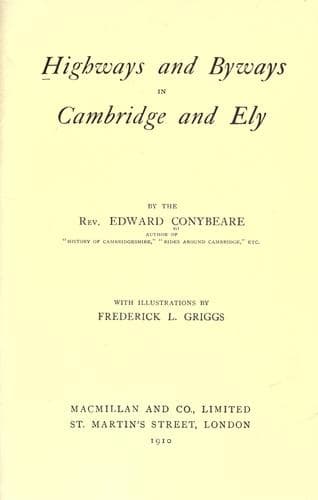
Highways and Byways in Cambridge and ElyConybeare, John William Edward
History
Highways and Byways in Cambridge and Ely
Conybeare, John William Edward
Cambridgeshire (England) -- Description and travel; Isle of Ely (England) -- Description and travel
Stetchworth Manor, in the tenth century, was given to the Abbey of
Ely, to provide clothing for a newly-professed monk, the son of the
donor. This sounds an extraordinarily disproportionate gift; but the
clothing of an Ely monk was really a very serious item, and, as the
Abbey account books show, cost the convent the equivalent of something
very like L50 per annum. Readers of Chaucer will remember how
comfortably, and even luxuriously, the monk of his "Canterbury Tales"
is dressed.
Of the remaining villages along this upland line there is not much to
tell.[141] They present a pleasant field for wandering exploration;
each has its picturesque features, no church is without something of
antiquarian interest, and over all broods a delicious aloofness.
Westley Waterless Church has a flint-built round tower, of the Norfolk
fashion, and a fine brass of 1325, representing Sir John de Creke and
his wife, Lady Alyne. He is shown wearing the curious surcoat then in
fashion, known as a _cyclas_, which, in front, reached only to the
waist, and, behind, to the knees. The lady is one of the first
examples of female portraiture in brass: her figure is strangely out
of drawing.
[Footnote 141: The frequent occurrence of "West" in their
names--Westley, Weston, West Wratting, West Wickham--reminds us that
their geographical and historical connection is with Suffolk, to the
east of them, rather than with Cambridgeshire.]
Weston Colville has also a brass, now affixed to the wall, and too
much damaged for identification. The church here is almost wholly
Early English, as is that of Dullingham. Borough Green contains some
fine twelfth century monuments, sadly knocked about. The Parson here
was ejected by the Puritan Earl of Manchester, Governor of Cambridge,
during the Civil War, for the heinous offence of saying "that he ought
to shorten his sermons rather than neglect reading the Common Prayer,
and that the Collects were to be preferred before preaching." Grounds
no less frivolous were a sufficient excuse for a like ejection of
half the parsons in Cambridgeshire at this period. The rest signed the
Covenant and renounced their Anglican heresies, sometimes with
considerable emphasis. One curate is recorded to have stamped the Book
of Common Prayer under his feet, in the face of the congregation,
declaring that he would henceforth be their minister "by no Prelatical
and Popish imposition of hands." Some score of these Vicars of Bray
lived to turn their coats once more at the Restoration.
Public-domain text, read in full here on John Shaqi.
Reviews
Reviews
No reviews yet
Be the first to share your thoughts on this work.
Elsewhere in the archive
Join the Discussion
Join the discussion
Sign in to leave a comment or review.
Sign InorCreate an account