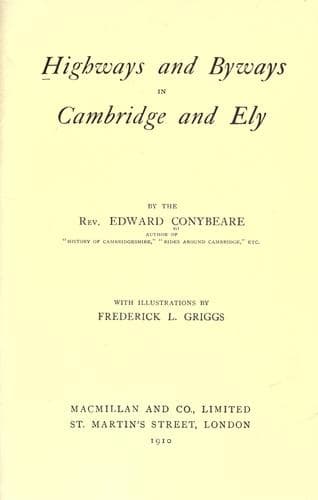
Highways and Byways in Cambridge and ElyConybeare, John William Edward
History
Highways and Byways in Cambridge and Ely
Conybeare, John William Edward
Cambridgeshire (England) -- Description and travel; Isle of Ely (England) -- Description and travel
Till the Restoration these represented two separate incumbencies; the
former having been given to the Abbey of Ely by Brithnoth, the heroic
Alderman of East Anglia under Ethelred the Unready. Both churches have
passed through singular architectural vicissitudes. The design of the
Norman tower of St. Mary's (the lower of the two), square below and
octagonal above, was copied by the fifteenth century builders of St.
Cyriac's, and is the only surviving portion of their work--the body of
the church having been pulled down in 1667, at the union of the
benefices.
[Illustration: _Swaffham Prior._]
A century later the steeple of St. Mary's was struck by lightning,
which occasioned so unreasoning a panic amongst the worshippers that
they resolved to abandon the church altogether. In vain did the Squire
(then, as now, one of the Allix family)[144] offer to repair the
damage, which was but slight, at his own charge. Nothing would serve
but dismantling St. Mary's and using its spoil towards the rebuilding
of St. Cyriac's, in the shape of a hideous brick tabernacle, of the
worst Georgian style, attached to the ancient tower. St. Mary's would
have been entirely pulled down had not the ancient masonry proved so
solid that the work of demolition did not pay the local builder who
got the job. As it was, it remained a ruin for yet another century,
and it was not till the end of the nineteenth that it was
restored--still under Allix auspices. Now it is once more the place of
worship, and contains a specially well-executed rood-screen. But the
beautiful spire which crowned the whole steeple still awaits
replacement. The Georgian St. Cyriac's yet stands, and is used as a
parish museum.
[Footnote 144: This family came into England amongst the Huguenot
refugees from France early in the eighteenth century.]
[Illustration: _Swaffham Prior Churches._]
From the churchyard of Swaffham Prior we get a grand view over the
limitless fen to the northward; Ely Cathedral, ten miles away, rising
conspicuous above it. The road we have been pursuing leads us on
Ely-wards; but, a mile hence, comes to a dead stop at the little
hamlet of Reach, once one of the most important places in the whole
county. For here the mighty earthwork of the Devil's Dyke runs down
into the fen. To meet it the greatest of all the Lodes was cut from
the Cam at Upware, and at its hithe (or quay) our road has its
termination. It is a striking surprise, for one comes upon it abruptly
round a corner, and suddenly finds oneself at the end of all things.
The hithe is a quiet green meadow now; but the clear brown water of
the lode still sleeps beside it, and even yet barges, laden with turf
or coal, occasionally creep up hither. Of old it was a constantly busy
spot, where sea-going ships were loaded and unloaded, and trains of
waggons attended, bringing and carrying off the cargoes.
[Illustration: _The Castle Moat, Burwell._]
Public-domain text, read in full here on John Shaqi.
Reviews
Reviews
No reviews yet
Be the first to share your thoughts on this work.
Elsewhere in the archive
Join the Discussion
Join the discussion
Sign in to leave a comment or review.
Sign InorCreate an account