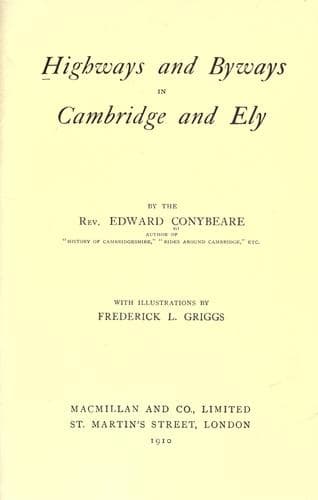
Highways and Byways in Cambridge and ElyConybeare, John William Edward
History
Highways and Byways in Cambridge and Ely
Conybeare, John William Edward
Cambridgeshire (England) -- Description and travel; Isle of Ely (England) -- Description and travel
Tradition gives Reach seven churches; but for this there is no
historical evidence whatever, and it is probably only a hyperbolical
way of extolling the ancient importance of the place. It is now merely
a chapelry under Swaffham Prior, in which parish the western side of
the township[145] is situated. For here the houses run in two lines,
about a hundred yards apart, with a little village green between, on a
gentle slope some quarter of a mile in length, having the fen level as
its lower boundary, and, for the upper, the stupendous bulk of the
Devil's Dyke, here cut clean off as if with a knife. All looks
ancientry itself; but, in fact, this cutting off of the Dyke is quite
a modern affair, not yet even two centuries old. Till then the Dyke
ran right through the village down to the fen itself, effectually
isolating the Swaffham Prior houses on the west from those on the
east, which belong parochially to Burwell. Cole, the prince of
Cambridgeshire chroniclers, whose voluminous MS. notes on the county
still await a publisher, mentions that when he visited Reach in 1743
the Dyke still reached the fen; but when he came again in 1768 he
found the present state of things. Of how, or by whom, this act of
vandalism was perpetrated I can find no record.
[Footnote 145: Reach is commonly spoken of as a "hamlet," but there is
still enough historical pride amongst the inhabitants to make them
resent this phrase.]
Reach was of importance even in Roman days. The Dyke, of course, was
already ancient when they ruled Britain, and the lode, too, may very
probably have been already cut. The remains of one of their villas
have been unearthed here, near the point where the Cambridge and
Mildenhall railway now cuts through the Dyke. It has a well-preserved
hypocaust, or apparatus for warming the house by hot air. The Roman
"villa," we must remember, was the country mansion of the period, and
equipped with every known luxury. In the Middle Ages the annual Fair
at Reach (on the Monday before Ascension Day) was big enough to bring
over the Mayor of Cambridge to open it. And the custom survives even
today, when the occasion has dwindled to a very petty little
gathering.
Reach, however, has still a local industry; the cutting of the peat,
or "turf" as it is here called, in the neighbouring fen, for use as
fuel. This peat forms a layer often many feet in thickness, and is
formed for the most part of moss, mingled with the vegetable mould
made by the decay of the dense forests with which the district was
covered for uncounted ages; before its final submergence, early in the
Christian era, destroyed the last of them. A like subsidence had more
than once produced the same results earlier; for the remains of four
or five forest beds at different levels have been found in the peat.
Public-domain text, read in full here on John Shaqi.
Reviews
Reviews
No reviews yet
Be the first to share your thoughts on this work.
Elsewhere in the archive
Join the Discussion
Join the discussion
Sign in to leave a comment or review.
Sign InorCreate an account