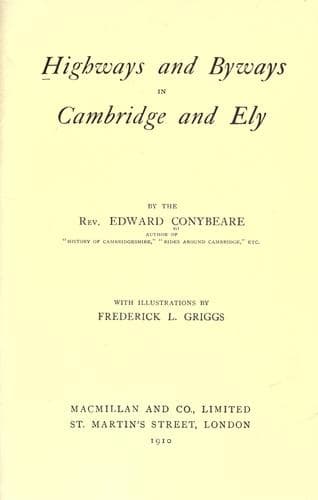
Highways and Byways in Cambridge and ElyConybeare, John William Edward
History
Highways and Byways in Cambridge and Ely
Conybeare, John William Edward
Cambridgeshire (England) -- Description and travel; Isle of Ely (England) -- Description and travel
The origin of this curious appellation is still to seek. According to
some archaeologists it is derived from the prehistoric figure of a
giant which was formerly to be seen on the slope, traced there by
cutting away the turf along the outline of the shape, such as that
still extant near Cerne Abbas in Dorsetshire. This, if it ever
existed, has long since disappeared. Others consider the name to be a
seventeenth century skit on the gigantic height of the hills. Others
again see in it a dim traditional recollection of the days when a set
of gigantic barbarians really were, for a time, quartered here. This
was in the reign of the Roman Emperor Probus (277 A.D.), who leavened
his mutinous British forces with prisoners from the Vandal horde
lately defeated by the Romans on the Danube. From one such detachment,
placed here in garrison, the name of Vandlebury is supposed to have
clung ever since to the great earthwork on the summit of the
Gog-Magogs.
That earthwork, however, is of far older date, being of British, or
even earlier, inception. It is a triple ring of gigantic ramparts,
like those of Maiden Castle near Dorchester, and nearly a mile in
circumference. All is now buried in the shrubberies of Gog-Magog
House, the seat successively of Lord Godolphin and of the Dukes of
Leeds.[147] But before being thus planted out it must have been one of
the most striking examples in the kingdom of such fortifications. Till
the eighteenth century it was a favourite scene of bull-baiting and
other illegal sports amongst undergraduates, because the bare open
country all round made it impossible for the authorities to surprise
the offenders. Vandlebury was the original home of the legend, used by
Sir Walter Scott in _Marmion_, which told how in the ancient camp, by
moonlight, an elfin warrior would answer the challenge of any
adventurous knight bold enough to encounter him in single combat.
[Footnote 147: It is now the residence of H. Gray Esq. In the stable
yard a monument records the celebrated "Godolphin," one of the first
Arabs (or, more probably Barbs) to be imported, at the beginning of
the eighteenth century, for the improvement of our thoroughbred
stock.]
In the early decades of the nineteenth century the then Duchess of
Leeds here set up for her tenantry one of the earliest rural
elementary schools. Children of both sexes were taught in this
institution to read and to sew, the boys making their own smock
frocks. The boys might, if they would, also learn, as an extra, to
write; but not the girls, for Her Grace considered that it would
deleteriously affect their prospects in domestic service if they were
possessed of the dangerous power of deciphering their employers'
correspondence.
Public-domain text, read in full here on John Shaqi.
Reviews
Reviews
No reviews yet
Be the first to share your thoughts on this work.
Elsewhere in the archive
Join the Discussion
Join the discussion
Sign in to leave a comment or review.
Sign InorCreate an account