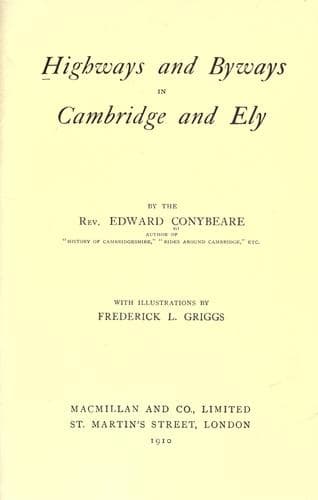
Highways and Byways in Cambridge and ElyConybeare, John William Edward
History
Highways and Byways in Cambridge and Ely
Conybeare, John William Edward
Cambridgeshire (England) -- Description and travel; Isle of Ely (England) -- Description and travel
The Devil's Dyke and the Fleam Dyke are by this time known as "the two
dykes of St. Edmund," and now play their latest part in history as
defences. Edward is no Ostorius, being a valiant warrior of the
cautious rather than the daring type, and the Fleam Dyke brings his
avenging host to a standstill. Finally he resolves that to storm it
would cost too much, and retires his command. But his levies from Kent
are of another temper, and positively refuse to obey what they look
upon as an ignominious order. One after another, seven royal
messengers repeat it in vain; and finally the main body of the English
army marches off under the Royal banner, leaving the mutineers still
before the Dyke--probably at the very point where the Icknield Way
cuts it.
This is the Danes' opportunity. They have now safely deposited their
plunder, and are ready for another outbreak. With their whole force
they sally forth, and fall upon these stubborn Kentish men, and the
fighting becomes desperate. The Kentish Alderman (who combined the
offices of High Sheriff and Lord Lieutenant) is slain, so is the
Danish King Eric, so is Ethelwald "the Atheling" himself, "and very
many with them. And great was the slaughter there made on either hand;
and of the Danish folk were there the more slain, yet won they the
field."[161] And thus, after so many ages of warfare, does the Fleam
Dyke, or Balsham Ditch, as it is also called, enter on its millennium
of peace.
[Footnote 161: _Anglo-Saxon Chronicle._]
[Illustration: _Balsham Tower._]
For it played no part in the tragedy which, a hundred years after this
last fight, is associated with its alternative name. Once more Danes
and Englishmen are at hand-grips; but now it is no mere loose
aggregate of private hordes pressing, each on its own, into the land,
but Swend Forkbeard, the monarch of a great Scandinavian Empire
purposing to add England also to his dominions. And under the weak
sceptre of Ethelred the Unready, nothing beyond local resistance has
been offered him; and here alone is the local resistance serious. East
Anglia is under the governorship of the hero Ulfcytel, who has already
given the Danes an unforgotten taste of his "hand-play," and he
gathers her whole force to meet them at Ringmere. But the appalling
tidings of what Swend has done elsewhere, "lighting his war-beacons
as he went" throughout the length and breadth of the land, "with his
three wonted comrades, fire, famine, and slaughter," have taken all
the heart out of the English levies. For "all England did quake before
him like a reed-bed rustling in the wind." The battle is speedily
over. "Soon fled the East Angles; there stood Grantabryg-shire fast
only."
Public-domain text, read in full here on John Shaqi.
Reviews
Reviews
No reviews yet
Be the first to share your thoughts on this work.
Elsewhere in the archive
Join the Discussion
Join the discussion
Sign in to leave a comment or review.
Sign InorCreate an account