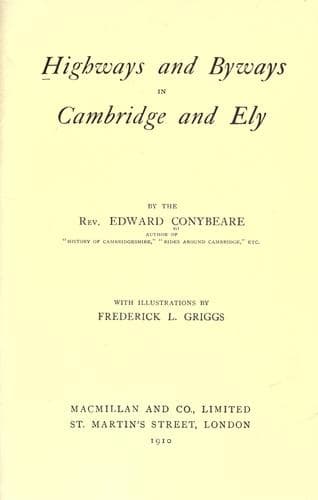
Highways and Byways in Cambridge and ElyConybeare, John William Edward
History
Highways and Byways in Cambridge and Ely
Conybeare, John William Edward
Cambridgeshire (England) -- Description and travel; Isle of Ely (England) -- Description and travel
The air is inspiring and so also is the view, with Ely on the far
horizon to the north; and the historical associations are not less so.
We can imagine the oaken palisade which topped the dyke lined with the
Icenian clansmen in their tartan plaids shouting defiance to the
presumptuous Roman who dared to demand their arms; then the incredibly
audacious onslaught which, along the whole length of the Dyke at once,
carried Ostorius and his light-armed troops at one rush clear across
the mighty ditch, and up the forty feet of precipitous slope beyond,
to crown the parapet and whirl away the patriot levies in headlong
flight; then the merciless pursuit which forbade any chance to rally,
till the fugitives were stopped by their own second line of defence
at the Devil's Dyke, and slaughtered like rats beneath its
rampart.[160]
[Footnote 160: See p. 172.]
[Illustration: _Great Wilbraham._]
Or our thoughts may turn to the later day when here was beheld the
last fight worthy to be called a battle ever fought in Cambridgeshire.
It is the year 905 A.D.; the great Alfred has been dead four years,
and his son Edward the Elder has been chosen King in his stead. For
the English monarchy is still elective, though already with a strong
tendency to become hereditary. And this tendency now gives trouble.
When Alfred himself was made King his nephew Ethelwald Clito, son of
his elder brother Ethelred, the late King, was passed over in his
favour. At that fearful crisis, when it was doubtful whether even an
Alfred could stem the Danish inrush, there could be no thought of
choosing a child as King.
[Illustration: _Little Wilbraham._]
But the Danes are now quietly settled in the Eastern Counties, and
Ethelwald has grown up to manhood, and is bitterly angry at being
again passed over, this time for his cousin Edward. If the English
will not choose him, he will try the Danes. So to the Danes he goes,
with promises of unlimited loot if they will support him, and, in the
words of the Anglo-Saxon Chronicle, "entices them to break the peace,"
so that they cross the Watling Street, and make a ferocious raid into
Mercia. "They took all they might lay hands on, and so turned homeward
again. Then after them came King Edward, as fast as he might gather
his force, and overran all their land between the Dykes and the Ouse,
as far North as the Fens."
Public-domain text, read in full here on John Shaqi.
Reviews
Reviews
No reviews yet
Be the first to share your thoughts on this work.
Elsewhere in the archive
Join the Discussion
Join the discussion
Sign in to leave a comment or review.
Sign InorCreate an account